
Making OKRs Lean Again
Objectives and Key Results. A 40-year old, simple goal-setting framework, initially created by and for technology companies that needed to innovate at the speed of light. They are still wildly relevant today, some four decades later, and when used correctly, they can help you to achieve 10x growth. The popularity of the tool is….
Objectives and Key Results. A 40-year old, simple goal-setting framework, initially created by and for technology companies that needed to innovate at the speed of light. They are still wildly relevant today, some four decades later, and when used correctly, they can help you to achieve 10x growth. The popularity of the tool is still rapidly growing, as measured by the number of software companies developing tooling for it. At the same time, we see companies abandoning them. Why is that? Why is there so much fuss about OKRs anyway? To paraphrase John Cutler: “[...] they are just goals!” They are supposed to be simple.
Let me tell you about a fictional character. Let’s call him Dave. Dave’s story will help to illustrate how most organizations start their OKR journey.
Click the links below to read the whole series and join Dave on his journey.
Now Available!

Categories
Making OKRs Lean Again - Final Part
Objectives and Key Results. A 40-year old, simple goal-setting framework, initially created by and for technology companies that needed to innovate at the speed of light. They are still wildly relevant today, some four decades later, and when used correctly, they can help you to achieve 10x growth. The popularity of the tool is….
Welcome back to the final installment of Dave’s story. Dave and his company experienced quite a few ups and downs when it came to OKRs. A lot of the challenges could have been avoided if they had put their OKRs on a diet (or what I like to call Lean OKRs).
Dave’s story isn’t all bad. There is one aspect of the story that I do like. I like the data-driven angle of Dave in this story: HR used measurements and information to initiate an organizational change. However, it’s based on the wrong assumption. Improved alignment, focus and engagement are how OKRs got sold by many consultants, but that is not the problem OKRs are trying to solve! These things are side-effects of proper goal-setting. There are many other ways to set goals on engagement, alignment and focus. Why not set SMART goals instead? Don’t bother then with using a tough-to-get-right framework like OKRs. Instead, ask this question: Why is the organization struggling to get alignment amongst teams and leaders in the first place? What is the core issue going on here?
In Dave’s story, it was Dave himself that initiated the change. However, this trigger can also come from different department managers as a reaction to low team morale, low-performing software teams, part of a framework like SAFe, or growth hackers that heard about them. It really doesn’t matter. OKRs won’t help you to fix these issues. They are all the wrong incentives to start using OKRs. Why? Because OKRs are created by and for B2C tech companies to execute ambitious strategies by empowering high-performing teams to work on hard problems. You are probably not that kind of company (just yet - maybe one day you will be and when that day comes, when you need a framework to achieve your moonshots, OKRs will be waiting!). That doesn’t mean OKRs cannot work for your company, but you need to put in a lot of effort to get some results.
You’ve probably spotted a lot of waste in Dave’s story that lead to the following symptoms: low employee engagement, overburdened people, lack of focus, context switching, too many conflicting priorities, a large inventory of goals (all they did was transform existing measurements and goals into a new format), a bloated goal-setting process. Don’t fight these symptoms, instead, get to the root of the problem. In the end, Dave’s company didn’t change and they didn’t benefit from OKRs at all. The side effect being that OKRs have gotten a bad rap because the intentions of working with them were misaligned to where OKRs really shine. Instead of piling goals on top of goals, we need to put OKRs on a diet. What if we apply Lean thinking principles to OKRs? We could make OKRs Lean again!
Lean OKRs - The foundation
It starts by understanding your strategy. There are many different strategies within a company. If you are small, you probably only have a company strategy. If you are bigger, you can have a strategy for your product(s). Having a strategy is key, without it, OKRs just won’t work! Then you need to think about what part of your strategy requires a radical improvement (we call this Kaikaku in Lean), a goal that requires a change in human behavior.
For B2C SaaS companies, to grow your company, you probably require different customer behavior. For example, to increase LTV, you need to make sure customers engage with your app more actively, or move them from a freemium to a paid subscription. Your product teams can then set OKRs to focus on these challenges. This is the preferred model.
For other companies, especially enterprise companies, using OKRs is even harder. Most of the time, teams are far away from the customers. But you are not entirely doomed. Instead, leaders in these companies can focus on an internal behavior change. For example, using internal APIs, improving how leaders communicate strategy, greeting customers in a different way, proactively reducing manual tasks, seeking feedback from customers, etc). OKRs are now used for Organizational Change, which requires a different approach, and could, with some strategic thinking, help to build modern product teams. Understanding the difference between the two is key. It doesn’t matter which company you’re in, OKRs are about solving hard problems. They are about changing human behavior.
The thing is this: If you need to execute a very ambitious strategy, then behavior change is part of that. Behavior change is hard and takes time. Have you ever tried to change your own behavior? Then try changing the behavior of your team or a whole group of customers. It now becomes even harder. It requires focus, dedication and accountability. At the same time, people have other stuff to do. “Business as usual” is the biggest enemy of OKRs. It is why companies and teams can focus on only ONE OKR at a time. On a company level AND on the team level. Cut down department OKRs or any OKR layer. Don’t use your organizational chart to set OKRs. It just makes everything more complex (there are some exceptions when you are a very big company, but I won’t go into details here). Instead, foster cross-departmental team collaboration and alignment. Let senior leaders plot a strategy for achieving the company-level OKRs. Let them define draft Objectives for their teams or let senior products teams swarm around the company OKR themselves. Let leaders fight on priorities and conflicting Objectives before the next cycle starts. Then they need to bring strategic context or their intent to their teams and collaborate with them on defining measurable key results (preferably focused on outcomes) and challenge them on their ambition level. OKRs are very ambitious goals. You always stop at the team level, not the individual level. They are a team sport. You cannot win the World Cup in soccer by yourself. You need a team.
Install a lightweight process
Next, you install a lightweight system to achieve the team goals. A system that is easy for everybody to adopt and can fold into existing ways of working (e.g. Scrum). That system is called the OKR cycle, and without it, OKRs won’t work! It’s the operating system to achieve bold goals and continuous organizational change.
The default Lean OKRs cycle is 90 days. It gives you and your teams enough time to make those behavior changes and build new habits. To stay accountable and measure progress, you need to check in on your OKRs every week. Look at the latest data, define obstacles and run experiments to remove them.
Mindset
It is this “scientific thinking” that will help your teams to move the needle on hard goals. It is “scientific thinking” that will create innovation, by letting the people close to the technology (and your customers!) solve hard problems. Can you teach your teams these skills? You should! Coach them. In the realm of Modern Product Development, teams and their managers use “scientific thinking” to explore and develop hypotheses to test. They have a whole arsenal of methods and techniques they can use to move the needle. And they have built the skills to run small experiments and to do so fast. Multiple per week even. If you want to use OKRs, your product team needs to master these skills. It’s not enough to convert existing goals and KPIs into OKRs and then tell everybody that you are “doing OKRs”. It’s not enough to ask people to work on a hard problem without the knowledge and expertise to do so. It’s not enough to only ship features to your customers. Probably half of them aren’t going to move the needle on your goals anyway (as Marty Cagan once said).
OKRs can look simple (and they are), however, it’s very hard to do them right. It requires slowing down first, changing people’s way of working. It requires people to think about problems to solve, to radically focus on one problem at a time, making tough decisions, fighting over priorities (and compromising), achieving consensus amongst leaders, behaviors to change, understanding that product teams will use OKRs differently than the rest of your organization, building strong data literacy, hiring strong leaders that are willing to coach people and empower teams, and having one-on-one’s every now and then. This stuff isn’t easy and it’s not for everyone. Are you prepared to change your way of working?
You have two choices when it comes to implementing OKRs. One, you use the OKR format to set your goals (you’ll reap some benefits, but not more than you would using SMART goals). Or, you use the Lean OKR approach I just explained to boost company and team performance to the next level.
How can we make OKRs lean again?
Here are three easy steps to make your OKRs Lean, which you can start implementing today!
In the next cycle, focus on ONE OKR per team at a time. Use strategic thinking. Focus on behavior change. Battle it out! Pick one high-performing team to start with.
Install a lightweight process to achieve your OKRs. Based on Plan, Do, Check, Act. Study and try scientific thinking with your team. Toyota Kata is a great resource to start.
Mindset. Teach and practice scientific thinking.
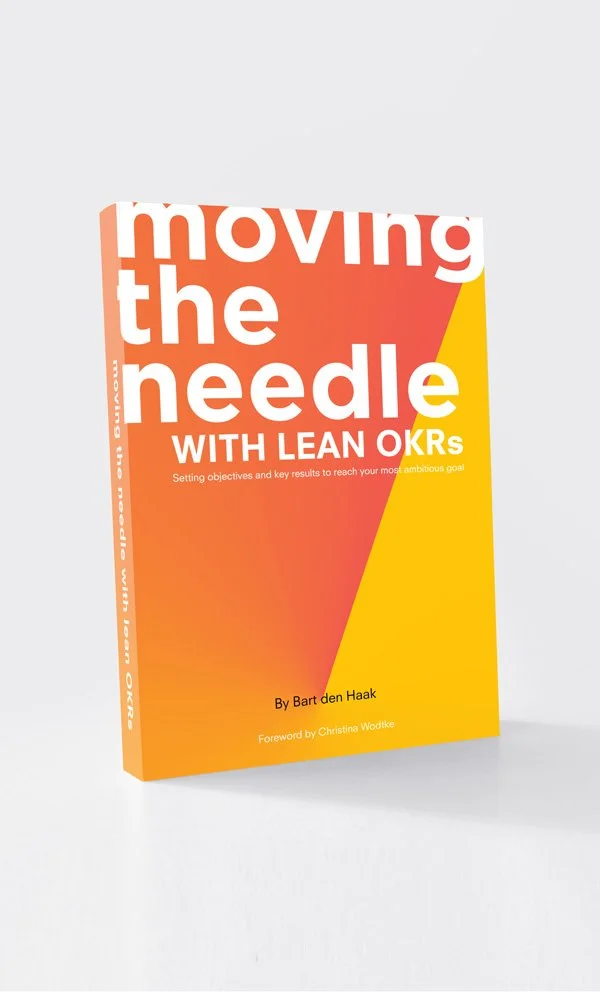
And with that, we wrap up our fictional character Dave’s story. For some people, this story isn’t too far off from real life. If you would like to know more about Lean OKRs, you can order my book “Moving the Needle with Lean OKRs” or you can contact me. I offer a free OKR discovery call for those that are ready to roll up their sleeves and get started with Lean OKRs within their company or organization.
Now Available!
Categories
Making OKRs Lean Again - Part 3
Objectives and Key Results. A 40-year old, simple goal-setting framework, initially created by and for technology companies that needed to innovate at the speed of light. They are still wildly relevant today, some four decades later, and when used correctly, they can help you to achieve 10x growth. The popularity of the tool is….
Welcome back to the third installment of Dave’s experience starting out with OKRs. As you know, the end of the quarter has arrived and their learning curve is huge.
End of the quarter
The end of the quarter arrived. Everyone was asked to report on their OKRs. Teams and departments reported little progress on their OKRs. The Sales team however did great! Dave had already informed Mary that this was to be expected. The first OKR cycle is for learning. All the OKR experts will tell you this. So they decided to give OKRs another try. Dave realized this OKR initiative took more effort than expected. But he learned from the literature that the process takes time, to be patient. He also learned that setting OKRs with so many people takes a lot of preparation. Dave had more on his plate these days, because of onboarding new employees, leading the talent acquisition team and increased sick leave. Therefore, he hired a program manager that could oversee OKRst. His name was Bob. Bob had years of experience in change management programs, so none of what the company was experiencing with OKRs was new to him. As good program managers do, he started to formalize the process. He created mandatory meetings for everybody to attend to smooth out the OKR process. With the company still growing, new people and teams popped up almost every quarter. When it came to setting OKRs for the upcoming quarter, it took three weeks to make sure everybody had filled in their OKRs into the software tool. Regardless, Bob was confident that he could mobilize such a large group of people every quarter to fill in their goals.
Not everybody was happy with the continuation of the OKR initiative within the company. Some people said there were too many meetings now. Some people didn’t enter their OKRs into the OKR software system. In response, Bob started to send automated email reminders to people: “PLEASE FILL IN YOUR OKRs”. After chasing people down, finally, most of them had submitted their OKRs.
This process continued on for almost nine months.
Evaluation
One day, Mary walked in and asked Dave: “We have been using OKRs for 3 quarters now, how is the engagement going on?” Dave responded: “Your timing is perfect! Yesterday, we ran another employee engagement survey, however, the results aren’t that great.” “Oh? How come?” asked his boss. “Well…,” John hesitated to share the findings with her because he didn’t like to be the bearer of bad news. “We only saw a small uptick in the engagement survey, it seems the OKRs didn’t work”. His boss looked confused. “How is that possible? Everybody has now clear goals defined, everything is now made transparent, why aren’t they working?” John replied: “People still complain that they’re missing the bigger picture.” He continued: “And they also don’t like working with OKRs because they see them as an administrative hassle”. His boss replied: “Mmmm, maybe this OKR thing is not for us. I don’t see very many results coming out of it anyway. Yesterday I had a meeting with one of our investors and he talked about OSGM and V2MOM or something. Let’s try that instead. I think it’s a better fit for us.” She looked at Dave: “By the way, can you prepare for the annual performance reviews, it is that time of year again! And we can definitely use the OKRs to evaluate people now.”
Analysis of the story
The problem with Dave’s story is that you probably believe it’s fiction. Unfortunately, this story is more real than you might believe. There are many things that went wrong that I’ve seen in real life, as well.
The main reasons that things go sideways when implementing OKRs are because there is an issue with one or more of the following:
Company culture. It is one based on a command-and-control model and doesn’t have empowered (product) teams.
Focus. There are too many OKRs and the “big picture” isn’t clear.
Purpose. Leaders fail to communicate why they want to use OKRs.
Routine. People get discouraged and disengage due to a lack of visible results (set & forget)
Autonomy: OKRs are set by management (not independent teams) and the OKR software manages the progress on those goals.
We see similar patterns when companies try to adopt “Agile working”, Scrum or trying to scale any of the Agile methods. “We have implemented Jira so we are Agile!” If you struggle to get these things working in your organization, then OKRs are an even tougher challenge for you.
Deciding to jump on the OKR train is usually triggered by some shocking report score, like a poor score in employee engagement. For some time the HR department has been tracking employee engagement and usually, for the lack of any better measurement, they use eNPS. Some more senior HR departments use a more sophisticated survey, like the OHI or Q12. These measurements happen every year or every half year. The trigger to start looking into OKRs is almost always a low score on purpose, lack of direction or low alignment.
The problem is that OKRs are primarily for B2C product-led companies with high-performing software teams. OKRs is Agile on steroids. If you can’t get the basic Agile stuff to work, if your teams don’t master software delivery, if they are not empowered, then OKRs aren’t for you. Well, not yet, at least!
There is a different approach to OKRs that has proven results in large or enterprise organizations. With careful timing, in combination with hiring strong product leaders, you could use OKRs for transforming your existing company culture into a modern product development culture. OKRs can act as the framework for continuous culture transformation.
In my next post and the final installment of Dave’s story, we’ll talk more about where it all went wrong (and what went right!).
Now Available!
Categories
Making OKRs Lean Again - Part 2
Objectives and Key Results. A 40-year old, simple goal-setting framework, initially created by and for technology companies that needed to innovate at the speed of light. They are still wildly relevant today, some four decades later, and when used correctly, they can help you to achieve 10x growth. The popularity of the tool is….
Welcome to the second installment of Dave’s story as he embarks on his OKR journey.
“I want to be able to manage all of these goals,” Mary told him. Dave did a quick search and within no time, he was able to select software that supported his needs. The nice part? The tool also supported the annual performance management AND they offered OKR training. “Isn’t that great?!,” Dave exclaimed, while showing the tool to Mary. The next day, with the approval of Mary, he purchased the OKR software tool. Based on his previous experience with performance management, he understands the importance of such a tool. It should not only help to keep track of people’s goals but also to maintain the transparency of OKRs (which he had learned was vital to the process).
The lovely people working for the OKR software tool company suggested getting some employees “OKR certified” to smoothen the OKR process. He quickly found some volunteers. The marketing intern, the Agile coach (because they are the company-wide “facilitators”, right?) and an engineering manager. They were sent to a one-day OKR training and within a week, all three received their certificate of completion.
“We are ready to start implementing OKRs,” Dave said to Mary. “Next week is the week before the quarter starts. Let’s set the OKRs then.”
Setting OKRs
It’s the following Monday and Dave is really excited about launching OKRs. The CEO gathered all senior management and announced that “...from now on, everybody needs to create OKRs in order to boost employee engagement. Not only will OKRs improve our low employee engagement score, but it will also help with alignment and focus”. She looked at James, the CTO, who is always a bit reluctant to new company changes, and continued: “We have trained some of your colleagues in OKRs and they are now certified internal coaches. They will be helping everybody to set their OKRs.” With a stern tone, she wrapped up by saying: “And I expect each of you to deliver your OKRs before Friday.”
And so it happened. Everybody in the company started to set OKRs. The executing team set OKRs first, then managers set their OKRs, then those same managers set OKRs for their departments: Marketing, Sales, IT, Customer Service, Operations, Engineering, R&D and UX. Then each team was asked to set OKRs, connecting to the department OKRs. And finally, every individual team member was asked to set OKRs themselves.
During the OKR setting process, people had figured out quite quickly that they could transform their current goals to fit the OKR template. So, the Sales teams changed their sales targets into OKRs, Marketing created OKRs for each campaign, Customer Service changed their “Time on the phone targets” to OKRs, Ops their “Uptime targets”, Software engineering their “roadmap items”, UX their retooling goals, and even HR re-wrote their “new hires targets” into OKRs. The leadership team did the same. Revenue, customer satisfaction and EBIT numbers got transformed into OKRs. Even each individual team member converted their personal development goals into OKRs, too!
This resulted in five OKRs at the company level. Five OKRs per department and manager, three to five OKRs per team and the same for each individual. It was as if they were sprinkling some magical OKR fairy dust over all of their existing (and mundane) goals. Lucky for them, they had the OKR software tool to help them manage all of their OKRs.
Dave was in charge of coordinating the OKR rollout, but after one week it was already apparent that not everyone was happy with the changes. He heard complaints from multiple people, such as “OKRs simply don’t work here”, “We also have other work to do, we’re drowning!”, “We already do Scrum, so why do we even need OKRs?” Dave was able to placate them by replying: “I hear what you’re saying but we really need to improve employee engagement and therefore OKRs are necessary”. It is worth mentioning, not everybody was unsatisfied with the changes. Some were quite happy that their leaders took action based on the employee engagement survey result, so they gave the leadership room to try OKRs out and proceeded without too much resistance (something that isn’t always the case in other companies).
During the Quarter
After all the OKRs were set, people got to work. They continued working on the tasks they were assigned to. Developers continued working on the features they received from product owners. After all, the Objective was to “Deliver awesome UI to customers.” UX kept working on the designs for the UI and handed them over to the engineering teams. However, they couldn’t deliver as fast as usual because their OKR was about converting their existing UX designs into a new tool, which took up a lot of their time. Marketing couldn’t make any progress on their OKRs either. They couldn’t launch their new marketing campaign because they depended on engineering to deliver the new UI. At the same time the Engineering team finally received new UI designs from the UX team, the company welcomed a new “big whale” client. The Sales team was on a roll to move the needle of their KRs. This required at least five software teams to pay attention to delivering on this.
At some point, the management team took a look at their OKR software tool and noticed that there was low progress on most of the OKRs. So, they decided to put some pressure on the Ops and software teams to deliver on time. Because the Operations team didn’t have time to automate their own work, they had a hard time with this new customer coming on board. Some teams were working overtime to deliver before the due dates of their “epics”.
The pressure seemed to work. The teams did some amazing work. They were able to push out the UI changes and a new feature before the deadline. “These OKRs work great!” some senior manager boasted over lunch.
The team moved back to working on features for this new major client. Meanwhile, there were new bugs coming in because existing customers were also using the new UI. Some software teams couldn’t focus on the OKRs or the major client anymore because of customer issues. “Maybe next quarter we can set OKRs for reducing bugs and do a big refactor project”, one of the software architects cleverly thought up.
Weeks went by and little progress was made on their OKRs as they worked to keep their heads above water.
In my next post, we will learn more about Dave and his bumpy start with OKRs. Until then, can you predict what the end of the quarter is going to look like for Dave’s company?
Now Available!
Categories
Making OKRs Lean Again - Part 1
Objectives and Key Results. A 40-year old, simple goal-setting framework, initially created by and for technology companies that needed to innovate at the speed of light. They are still wildly relevant today, some four decades later, and when used correctly, they can help you to achieve 10x growth. The popularity of the tool is….
Objectives and Key Results. A 40-year old, simple goal-setting framework, initially created by and for technology companies that needed to innovate at the speed of light. They are still wildly relevant today, some four decades later, and when used correctly, they can help you to achieve 10x growth. The popularity of the tool is still rapidly growing, as measured by the number of software companies developing tooling for it. At the same time, we see companies abandoning them. Why is that? Why is there so much fuss about OKRs anyway? To paraphrase John Cutler: “[...] they are just goals!” They are supposed to be simple.
Let me tell you about a fictional character. Let’s call him Dave. Dave’s story will help to illustrate how most organizations start their OKR journey.
Dave is the HR manager of ACME, a cloud-native scale-up company that develops software to help sales teams find new business contacts. The company grew very fast last year. It went from 200k MRR to 1Mi MRR over 5 years. It now has about 150 employees, distributed over three countries. The leadership team still wants to grow the company and take it to “the next level”. Lately, the company has had some problems with finding and keeping good tech talent. The employee retention rate is very low, especially in engineering. Therefore, Dave decided to do an Employee Engagement survey to find out what was going on. When the results came back, he quickly found out that one topic in particular stood out: People wanted to have a clear direction, focus and better alignment (which was currently absent, according to a very large majority, despite there being a strategy paper that was written and shared back in December).
It’s Sunday morning and Dave is reading his favorite HR magazine and learns about OKRs for the first time. He gets really excited when he reads about how this tool has boosted morale, alignment and engagement in a company similar to his. This tool looks very promising; it seems like a simplified version of an employee performance system. Simplicity is key, which is something that Dave values. It makes perfect sense to start using OKRs to see if will help to “fix” the employee engagement problems within his company.
That same week, Dave dove into OKRs and spent some of his evenings researching the topic. He did a Google search and quickly found some interesting articles but also found that the information available was a bit scattered, so he bought a book on OKRs. Two weeks later, Dave read the book cover to cover and was convinced. This can really help the company improve engagement! The next day, he sits down with Mary, the CEO of the company. He tells her what he had learned and how this new tool could help boost employee engagement, and thus, retention. Getting Mary on board with OKRs was easy. Who doesn’t want to have highly engaged people? Within thirty minutes, they agreed: “Let’s start using them in the next quarter”. The start of the next quarter was coming up in three weeks’ time.
In the next post, we continue with Dave’s story. Until then, how hard do you think it could possibly be for Dave’s company to implement OKRs?
Now Available!
Categories

The 10 most used KPIs that every CTOs in FinTech need to monitor and influence
Key Performance Indicators (KPI) often function as the main framework for the many measurables that your organisation collects or otherwise keeps track of. But which KPIs will actually help you answer the critical questions that will help your company increase revenue and reduce costs?

Key Performance Indicators (KPI) often function as the main framework for the many metrics that your organisation collects or otherwise keeps track of. But which KPIs will actually help you answer the critical questions that will help your company increase revenue and reduce costs?
In short, all of your KPIs should be able to give you crystal clear answers to these three simple questions:
Are we achieving our target or goal?
Are we improving?
What do we need to know to improve?
Based on my experience working with FinTech companies, my guess is that you might be falling short of the mark based on the above questions. Many companies don’t measure key metrics at all, nor do they have the correct baselines in place. They are lagging behind by several months, cannot connect metrics together and are likely analyzing ineffective data.
How this guide helps you
When it comes to software product development, there are hundreds of metrics you can keep track of, picking the best ones for you is an art. With the 10 KPIs presented in this guide, you can measure what matters. Use these as a starting point and select only a handful of them to monitor the performance of your organization. You can then extend and build upon them. Measuring these 10 KPIs can help you:
answer the questions stated above
prove what your gut feeling was already telling you
provide clarity on what actually moves the needle
remove the uncertainty of validating your decisions.
Download the PDF with the 10 KPIs that every CTOs in fintech product-led companies need to monitor and influence in order to improve their performance in 2021.
Since 2015, Moving the Needle has supported hundreds of leaders in B2B SaaS software startups and scale-ups, to identify their true north, set up processes to become autonomous, entrepreneurial and pragmatic in achieving their goal. I know first-hand about the struggles of managing a B2B SaaS company. I understand how difficult it can be to get to the core of what really matters and the boldness it takes to motivate everyone to focus on what’s needed to get there. Every company is unique and there is no cookie-cutter solution to every context-specific problem.
Beyond these 10 metrics, Moving the Needle has a vast library of metrics which might be even better for your specific situation. Interested in getting to know what actually helps you move your needle? Get in touch for a free Discovery Call.

OKR Software is a scam!
You don’t need dedicated OKR Software, so don’t fall into this trap. Organising your goals into Objectives and Key Results (OKRs) is supposed to be simple. Very simple, that’s why it works. If you make OKRs too complicated by having too many, or when you have too many layers in your organisation, you might think you need software to “manage” all these goals. Don’t “manage” OKRs; trust your teams instead to do the right thing.
Dear Manager,
You don’t need dedicated OKR Software, so don’t fall into this trap. Organising your goals into Objectives and Key Results (OKRs) is supposed to be simple. Very simple, that’s why it works. If you make OKRs too complicated by having too many, or when you have too many layers in your organisation, you might think you need software to “manage” all these goals. Don’t “manage” OKRs; trust your teams instead to do the right thing.

Painting of Sigmar Polke. Gangster, 1988, Reiner Speck Collection.
There hasn’t been a month without businesses contacting me about their “OKR Software Solution”. Some of them are startups; others are established players in the field. They all want me to review and evaluate their products. Although it’s often hard for them to hear, I always tell them, companies don’t need dedicated software to “manage” OKRs. It’s a gimmick, a toy for managers to get a perceived idea of control, alignment and overview. There are things you simply cannot fix with software. I’m a software developer by heart, so I would be the first to automate something to make people’s lives easier. With OKR software, it’s the other way around. People don’t like to use it, don’t want to use it, and it’s a waste of money.
Why OKR Software is money down the drain
The main reason why companies end up with hundreds of OKRs across their organisation is because they have been using OKRs the wrong way. By that, I mean, the majority of OKR users I have come across use OKRs as some sort of (high-level) project/initiative management tool. To manage their business as usual. Maybe because they have been set on the wrong path by the Measure What Matters book by John Doerr. The book uses a Google classification of OKRs, a division of OKRs into two “buckets”: Committed Objectives and Aspirational Objectives. Suddenly, people start to believe that having eight operational OKRs at the company level is just fine. Eight times three to four KRs, and you will end up with 32 KRs and hundreds of downstream OKRs that might “potentially” contribute to one of the 32 KRs. There goes your ability to execute, no wonder you need software to manage all this.
The so-called Committed Objectives are nothing more than operational, business as usual, goals. But John Doerr also wrote very clearly: “…the relative weighting of these two baskets is a cultural question. It will vary from one organisation to the next and from quarter to quarter”. Yes, your company shouldn’t always be in the highest mode of innovation and acceleration. Sometimes being modest in your goals is perfectly okay. Sometimes only a small change will do the job of executing your strategy. That doesn’t mean your whole organisation should use hundreds of operational OKRs to replace your initiative or project management processes. A single OKR that focuses on improving elements of your daily operation is fine, but just because you can manage all your operational goals with OKRs, doesn’t mean you should. And just because you can manage your projects and initiatives with OKRs, doesn’t mean you should do that either.
The more OKRs you need to “manage”, the more complex it will get. When you have many OKRs, selecting dedicated OKR software looks like a natural thing to do, but in fact it will make your goal-setting process even more complicated. This is what the OKR software scam is all about. The OKR software vendors benefit significantly from the fact that you have hundreds of goals entering their system, but who will enter all these goals? That’s right, your employees, and before you know it, your OKR software system will become the next time-keeping system. Just like time-keeping, people will hate to enter their goals and track their progress in that system. People will lose interest, set and forget goals, and become demotivated. Eventually, they will blame OKRs for that. I’ve seen this scenario so many times over the past decade. Ultimately, your OKR initiative will die, and your company hasn’t moved forward.
Brain overload

Photo by camilo jimenez
I’ve encountered so many companies where the managers complain that nobody fills in their OKRs on time (sounds similar to timesheets, right?). It’s because nobody cares about setting operational or activity-based goals. What would be the incentive for people to fill them in? They don’t get rewarded for their effort, and compensation is detached from OKRs (I hope). Frankly, your employees don’t care about your operational goals. Most of them don’t like using KPIs, measures and metrics. So how do you get people involved in your strategy? How do you engage people in developing metrics and OKRs for your success? Well, you need to engage them early in the process and develop OKRs that people care about. It starts by answering “why OKRs are important” to your business.
Even when you set the right goals, with the right OKRs, people are still overloaded with tools they need to use and maintain: timesheet systems, bug report systems, kanban/scrum board card, wiki pages, shared folders, etc. OKR software vendors would love to add another tool to this ever-growing list of software we use daily. For what reason? Why should I, an employee, care to put my goals in a software system if I can simply put my OKRs on a sheet of paper, whiteboard, or wiki page? You aren’t solving the employee’s problem of being “disconnected from the strategy”, rather you are trying to fix a manager’s problem: a lack of control, alignment and overview. If this is the case, you can say goodbye to peace of mind, and farewell to a successful OKR implementation. On the other hand, if you have one or two OKRs at the company level, and only one OKR at the department or team level, you keep things simple. People love clarity and simplicity. Only then can everyone successfully focus on what matters most.
Let’s examine some of the typical arguments people have for using OKR software.
Argument 1: OKR Software helps to keep overview
A manager could argue that: “We want people to see one OKRs relationship with other OKRs”. My response would be: If your goal structure is that difficult and complex, you might want to revisit. I know an international company with a 20k headcount managing their OKRs on a single Word document shared on a Microsoft Sharepoint drive. How much overview do you want? You want an overview of all the goals in your organisation? Great, but really why? You mean teams should see the goals of other teams, so they don’t conflict with each other? Why bother? Do you really believe a team will look into a software system to find out what another team is doing? Did they ever have the time to read the [ANY DOCUMENT] the other team wrote? Why do you believe it will be different now?
You don’t need that much overview if you only have a single OKR at company level and single OKRs at team level. If your organization is large, only the context will shift. Now the team will not directly influence the Company KRs, but they will impact the country or division KRs. Again, with a single OKR. Does the executive suite then need to know about all the team goals? Of course not; as long as they see their OKR moving in the right direction, everything should be fine. If not, you evaluate, review and repeat. That is the power of OKRs. To learn about your organisation and to improve. Having an overview of all the OKRs floating around in your organisation doesn’t contribute to that purpose.
Argument 2: OKR software helps with alignment
I often hear the argument that OKR software will help with alignment. Yes, a successful OKR implementation should increase alignment between teams and organisations. One reason for this is, you could remove some of the direct reporting lines when you develop a shared OKR. A single OKR that is shared across departments will accelerate alignment. Or you could set a single OKR at division level only, so that all the teams within this division need to work together on this common goal. However, if you keep your organisation structure as is and ask teams to enter their OKRs in a software system, you won’t then magically get alignment. All you get are isolated OKRs, sitting safely in their silos. You still need to put a lot of effort into getting organisational alignment. OKRs can help here, but it still requires strong leadership skills to get alignment in place. OKRs won’t fix this for you overnight, let alone dedicated OKR software that lets you keep your organisation’s structure intact.
Argument 3: Use software to control your OKRs
Should you use software to control OKRs? You don’t manage or control goals – you set and achieve them. Neither are OKRs a tool to control people (although you could misuse OKRs for that purpose). If you are a CEO of a company, why do you even care what kind of goals your downstream departments or teams set? You don’t trust the teams? Well, that’s a whole other story. Maybe, you need to change your role as a manager to that of a coach. What if you coach people to set better goals? What if you can help people to understand your business better? You don’t have time for that? That, again, is a different problem. You shouldn’t control people. Not with OKRs, and not with OKR software. Build trust instead.
What tools should you use instead?
Of course, you want to write down and communicate about your OKRs, to create transparency in your organization and to collaborate with other people on them. What tools do work? Here are some solutions I recommend you use.
Offline OKR Tools
When everybody is in the same room or office, collaboration and communication is much easier. In these conditions you can use the following tools:
Whiteboard, markers, flip-over. It’s about the discussions.
Pen and paper (or sticky notes).
Print them on paper and hang them on the coffee machine, water cooler, walls etc. Make sure you update the metrics on a weekly basis. This might be some work, but it’s worth it, trust me.
Online OKR Tools (for remote teams, COVID-19 proof)
Email. Send a weekly update to everybody in your team. Put your manager in CC.
Evernote, Google Keep, or other note taking apps.
Mural, Miro, Google Jamboard, or other whiteboard tool
Google Docs (Sheets or Docs). See my free OKR template here.
For your dashboard: Google Data Studio, Tableau, BowerBI, DataDog or similar data dashboard tools. This will integrate your analytics (KPIs) automatically.
Word document or Powerpoint on a shared drive (e.g. Sharepoint, Dropbox, Google Drive). Companies with 20.000+ employees also use this solution, and it works perfectly.
Wiki Page. Just one. Or one per team. You can hyperlink to each other.
Intranet page. Many big companies have one. Just publish your OKRs there.
Microsoft Teams, Slack
Build your own (Google did). If you have a developer, it should take him or her one day to create.
To conclude
I wrote this post out of frustration, and to challenge the notion that software always provides a solution, when in fact it may be neither ideal nor necessary. I hope this article will be a wake-up call for many organisations who need to rethink how they use OKRs and OKR software in particular. If you are still certain you need OKR software, here are some final points for consideration:
Making an exception, when might you decide to get OKR software?
If you are purchasing another software tool (e.g. hiring, HR, continuous performance review tooling, etc), you might find you get the OKR piece for free. But you should only buy the tool for its primary function (which is not OKR).
The organisation doesn’t like the current collaboration tooling, and the OKR software plus all of its features will be way better than what you currently have.
But remember
People could feel that the tool is like a time-keeping sheet and lose interest in updating it. Make sure you have the correct organisational behavior in place to make the best use of the tool. Make sure it integrates well with your existing collaboration suite to avoid yet-other-tool fatigue.
As of date, none of the OKR software integrates well with your existing KPI dashboards or analytics systems. You need to enter all data manually, every single week.
EU based enterprise companies usually don’t want to put their sensitive strategic information into a cloud tool that hosts their data in the USA or elsewhere. (The other way around also applies). Make sure you have a contract in place regarding the safety of your data.
Recap
When you install OKRs in your organisation, beware of some common pitfalls:
Don’t start with OKR software straight away.
Keep OKRs simple, starting with just one or a few. Don’t squeeze all your operation goals into OKRs.
When you do need software for the sake of online collaboration, use simple existing tools.
Don’t manage your organisation with OKRs; instead, trust your teams to move the needle on your company OKRs.
Allowing goals to become fragmented into endless subgoals only dilutes focus and scatters efforts. Goals/OKRs should be a rallying point, drawing people together and forward.
In my upcoming book, I will explain more on how to use OKRs in practice. Sign up for my book updates and get the latest updates.

Mission Impossible? OKRs to the Rescue
Many organizations that make the decision to start with OKRs make the same mistake: too many OKRs at the executive level.
Trickle Down?

Photo by SpaceX on Unsplash
Many organizations that make the decision to start with OKRs make the same mistake: too many OKRs at the executive level. There is a well-known management consulting firm (I won’t name names), that is still sending out junior consultants that advise that you should execute your complete strategy by only using OKRs. This development worries me a lot. As a consequence, people will continue to complain about a lack of focus and direction. Even worse, if you try to capture all your “business as usual” activities using OKRs, then what is the point of using OKRs in the first place? OKR is not a tool to replace operational management tools and techniques, therefore it is easy to predict that if this is your approach, you probably won’t achieve any of your goals and, before you know it, OKRs will be the next management fad in your organization. No kidding!
KISS
If you have 5 Objectives at the executive or management level and each has five Key Results, then basic math tells you that you end up with 25 goals. No wonder your employees are complaining that “OKRs don’t work” and are struggling to focus. No wonder you need to buy expensive OKR software that tries to manage all this OKR complexity, making you (in turn) a micromanager, constantly tracking what your teams are up to. This isn’t a great foot to start off on when building trust with your teams. If you don’t trust your teams to do their best work, then you have a bigger problem to solve. Great OKR implementation doesn’t require a complex tool. Do you really want to see all the dependencies and interconnectedness amongst the layers of staff below you, so you can busy yourself with managing their every move?
I’m sure you can tell, my stance of transparency and alignment is a core value of mine. If your teams don’t align with each other now, OKRs won’t magically solve that problem, even less so by inputting their activities into a software system. In some instances, such as working with remote teams, software is a useful tool, but it is not the recipe for success. Try to keep your OKR implementation simple and stupid, just as the old adage goes: KISS – Keep It Simple, Stupid.
Radial Focus
If you don’t focus, if you don’t make tough decisions, OKRs won’t make that much of a difference to your organization. Multiple OKRs at the executive or management level might help to improve alignment and transparency, but it won’t help with focus. Achieving Objectives such as reaching 10x growth and making a significant impact on the bottom line will be a very long and arduous journey for those teams responsible for carrying the load.
In my opinion, OKRs are about extreme or radical focus. That doesn’t mean you shouldn’t track other things in your business. If your goal is to run a marathon within a certain time, you’re still going to need to track and monitor your heartbeat, hydration, and speed. If you run too fast at the beginning, you will be exhausted midway and may not be able to even finish. Put poetically, and quoting author Jim Stuart: “To achieve a goal you have never achieved before, you must start doing things you have never done before”.
With an unhealthy company, you can’t make a difference in the world, it’s that simple. While you stretch and try to reach your ambitious targets, you still need to monitor your “business as usual”, day-to-day operations (or whirlwind, as we discussed in the blogpost “Getting the Grade: Tracking OKR & Confidence Levels”. In fact, the perfect tool for monitoring performance of your “business as usual” (BaU) are Key Performance Indicators or KPIs. There are many different indicators that are appropriate for the various levels of staff, ranging from department-specific to company wide.
The world of KPIs and OKRs are intertwined; In fact, you will likely use KPIs to monitor the impact of your OKRs, keeping an eye on them as you’re trying to reach your challenging goal. Note that KPIs and OKRs are not created equal: OKRs are a framework defining (often) quarterly goals; KPIs are figures for measuring the success of your strategy. By maintaining some targets on KPIs, it will overcome the problem of “Goals gone wild”, but this is not the realm of OKRs. OKRs are about focus, about changing human behavior (internal or external). The idea of KPIs is that they are used to monitor company or team performance. OKRs (when used correctly) can have a significant impact on KPIs.
The Land of OKR Masters
Once you master OKRs, you will understand that a minimalistic approach will actually provide you with more focus and better results. If you have made it this far, you can start experimenting with a single OKR at the top level. Sometimes called a “mission OKR”. We dove into this topic in the blogpost “Clarity with a Single OKR”. Recently, Christina Wodtke also wrote a post for Medium on this very topic: Cascading OKRs at Scale. In her article, she discusses the difference between having Company OKRs “trickle down” from the executive level in comparison with the ideal implementation of OKRs being interwoven between departments and levels of staff, where all teams involved are equally focused and working hand-in-hand.
A brilliant and relatable example of “extreme focus” is YouTube and their “key objective” which is technically a Key Result, of having “1 billion hours of watch time per day”. It took them four years to realize this OKR. Did they have any other OKRs at the company level? Not at all. Just one OKR. The result is a worldwide phenomenon: they are the market leader in online video streaming.
What If Teams Cannot Contribute?

Business As Usual vs OKRs
If you are able to provide this extreme focus to your departments and teams, you could run the risk that not all teams can contribute to the company’s OKR. That’s okay! It is totally fine if not all teams or departments can contribute. I don’t understand the idea of mandatory participation. I’m really glad to read that Christina Wodtke has a similar take on this.
Of course, other teams might contribute to various degrees, perhaps only marginally. Your role as a leader is to guide them on where they can contribute, even if it is only a little bit. Even 1% could help to propel the company forward. Sometimes teams can contribute 10% of their time to OKRs, sometimes 90% of their time. It really depends on the nature of the current company OKR.
But what if you have an OKR that has a focus only on your product? How can your Finance department, for example, contribute? Should they even be expected to contribute?
An Alternative Approach: Team Mission OKRs

Mission OKRs
As mentioned only briefly in the book of Paul Niven and Ben Lamorte, they talk about Mission OKRs for teams. The idea is the same as having a company mission OKR. Each team or department in your organization will create a mission OKRs. Not only will that help with finding the team’s purpose, but it is also an opportunity for leadership to have healthy conversations with the teams about why they exist. If every team could maybe “pitch” their mission OKR to the executives, management could provide constructive feedback to help the team refine its purpose and mission OKR, specifically in aligning with the mission, vision and values of the company.
If in one OKR cycle (let’s assume here that it is quarterly) the team cannot contribute to the company OKR, then they can continue with their own mission OKR (which is aligned with the company mission). How powerful is that?! You give more autonomy and trust to the teams and department because you know they will work on the most important thing, even if they cannot always contribute to the company’s OKR as other teams can, they are still contributing to the company’s overall longevity.
Give me a call if you want to explore how OKRs can work to help you with your growth strategy.

Barriers to growth
You want your company to grow. That desire could be driven by shareholders and investors, your own ambition or your exit strategy. So what do you do? You hire a bunch of growth hackers to get your inbound and outbound marketing up to speed, hire some killer sales reps and do some pricing tricks. This is a nice recipe if you want to grow your SaaS fast in its early days. After you have overcome some of the growth crises, you’re now a mature mid-sized SaaS company. Then something happens.
Growing up

Photo by Tim Collins
You want your company to grow. That desire could be driven by shareholders and investors, your own ambition or your exit strategy. So what do you do? You hire a bunch of growth hackers to get your inbound and outbound marketing up to speed, hire some killer sales reps and do some pricing tricks. This is a nice recipe if you want to grow your SaaS fast in its early days.
After you have overcome some of the growth crises, you’re now a mature mid-sized SaaS company. Then something happens.
Your number one enemy to growth: Complexity
According to a recent HBR article on a study of mid-size companies, it seems that an increasing percentage of firms incur losses, have lower profits, and have lower growth despite spending larger amounts on experimentation and innovation. Another study showed that eighty-five percent of executives say that the greatest barriers to achieving their growth objectives lie inside their own four walls, according to research by Bain & Company.
This is because of the “growth paradox”: Growth creates complexity and yet complexity is the number one killer of profitable growth. In my view, there are three types of complexity in a software company that are true barriers for growth; organizational, process and product (software) complexity. It turns out that these are very closely related.
Organizational Complexity
75% percent of executives will cite factors relating to organizational effectiveness as the cause of prevented growth. There are five ways that bureaucracy distorts behavior in your company, preventing you from sustainable growth: Speed, Motive, Time, Decisions, and Information.
With the distortion of speed, you can expect challenges with changes, pivoting, and delivery. When it comes to the distortion of motive, we see that as companies grow, things like promotions complex scorecards for performance take more of a corporate form, leading to regression and dissatisfaction. For distortion of time, I am reminded of the phrase: “death by PowerPoint”. This distortion takes the form of more and more meetings, pre-meetings, and presentations that slowly take over calendars and agendas and go overtime. By the distortion of decisions, we refer to the maze of approvals by various parties; this is not only inefficient, but when you have too many cooks in the kitchen, it isn’t long until the initial purpose is also distorted or not addressed. Lastly, when it comes to the distortion of information, you will likely recognise this by a comparison of how things “used to be” when management mingled with the staff and everyone was on the up and up when it came to mission, vision and understanding the ins-and-outs of the products or services provided.
Process Complexity
As if insidiously, processes grow increasingly complex as, in response to “not enough time in the day” and “this needs to be solved as of yesterday”, we see temporary Band-Aid-like solutions applied. This is the equivalent of solving hurricane damage to your home with duct tape and old newspapers; it may work for the time being…until the next hurricane arrives. All of these temporary fixes like stringent approval processes, task specialisation, and lengthy quality assurance protocol, create a process that is slow and expensive to operate in the long-term.
It is my belief that SAFe is a great example of process complexity. Do you really need all this process complexity to delight and satisfy your customers?
Just as your organization and processes is exposed to complexity, your product, the software itself, doesn’t come out of this unscathed either. The problem is that software complexity is way less visible. Both seem very related to each other, also known as Conway’s Law. Complex code is very hard to maintain, produces more defects and will dramatically increase the time to ship new features.
The biggest barrier to growth: Technical Debt

Photo by NeONBRAND
If you want to achieve growth or your growth-related OKRs, then it’s not only the organizational complexity that will prevent growth. The biggest barrier to growth is technical debt! Technical debt is a term used to indicate the growing amount of maintenance costs. This can be caused by many things:
Engineering shortcuts made in the growing-up phase leading to increase in complexity.
Outdated technology; for example libraries.
Low-quality developers – not all developers are created equal and it is almost impossible to hire all A-quality developers. Some experts suggest tracking development quality by tracking lines of code. High-quality developers write efficient code. Problems here could indicate a need to improve hiring, training and overall development management.
Procrastination with fixing defects. All code has defects, although good testing can minimize defects. If defect fixing is not well managed, defects can multiply into unacceptable tech debt.
Less attention to quality because of the continuous pressure to deliver new features to the market.
Poor project planning.
Low team morale; unmotivated teams do only what is necessary and won’t run the extra mile to deliver great software.
Whatever the reason, deliberate or unaware, engineers create technical debt and that is because of the laws of thermodynamics. In a recent article by Stepsize titled “The simple reasons tech debt is inevitable,” they lay it out best: “High-growth software companies constantly battle with this force. They raise a round of funding, double the size of their engineering team as quickly as the labour market will allow, and then have to deal with the massive increase of ‘energy’ in their codebase. It’s often overwhelming and it can lead to a sharp increase in technical debt if they fail to implement countermeasures.”
Similar to financial debt where money is borrowed, in software engineering this means borrowing some time to deliver features faster to the market. This can be necessary if you’re trying to find market fit or disturb to a new market. However, at some moment, you need to pay the bill. Every month, you add new technical debt and the interest rate gets more and more expensive.
Engineers spend approximately 33% of their time dealing with technical debt which crushes team morale and costs companies on average $85Bn per year. Research by Stripe
https://blog.stepsize.com/laws-of-tech-debt-part-i-macro-trends-that-make-tech-debt-inevitable/
An average software team of more or less 5 developers, each with an average salary of $100k, costs around ±500k per year, from which 17.2 hours per week on average is spent on tech debt. You can do the math if your company is bigger than a single software team. If we are looking at developers with an average work week of 50 hours, we can safely estimate that about a third of their time (and therefore also a third of what your company is paying them) is going towards putting out fires rather than innovating, developing new products or services, or new client acquisition. In essence, you will effectively cripple yourself from growing. A worthwhile action to take is to monitor the annual spending on tech debt as part of the Research & Development budget and include it in your SaaS KPI reporting so that the drag on efficiency is transparent and clear to all. It goes without saying at this point, but tech debt not only impacts the financial health of your company, but is also related to the 5 distortions mentioned above, and the trickle down effect is noticeable at all levels of staff.
Tech Debt is Ultimately an Indicator of SaaS Health
For every moment that a quality developer is utilizing his or her time to band-aid solutions or temporary fixes due to time crunches or other demands, that is too much time spent on detecting and fixing defects or maintenance rather than on delivering new, improved, cutting-edge products. What a waste of their highly-sought-after skills and the drag on your bottom line.
Setting aside their lack-luster job satisfaction, this also goes so far as to impact new client acquisition. Despite loyalty, when faced with a lesser-than product or a platform full of bugs, you are much less likely to convince them to expand their usage. Any SaaS CFO worth their salt will want to live and breathe their company’s performance and should consider tech debt the leading factor for unsatisfactory results, especially when it comes to growth, revenue, retention, and client expansion.
Using OKRs to Fight Technical Debt
If you have ambitions to grow beyond where you are right now with your SaaS company, I suggest adopting at least one OKR or KR related to technical debt. Start fighting it today. If you want to sell your company and are doing technical due diligence, you had better have your software system in a good shape. Also, you owe it to your employees, your engineers, for them to work in an engineering culture where quality is embedded in the way of working and mindset of the team.
Do you want to move the needle on your technical debt OKRs?
Let’s schedule a call with me.

OKR Check-In Learning Curve - What to Expect in the First Year (Quarterly Cadence)
You’ve recently started with OKRs, defined company-level OKRs and your teams already have linked OKRs. You are ready to start your first OKR cycle. What things can you expect when you perform your OKR check-ins? Let’s look at different stages of your OKR implementation.
You’ve recently started with OKRs, defined company-level OKRs and your teams already have linked OKRs. You are ready to start your first OKR cycle. What things can you expect when you perform your OKR check-ins? Let’s look at different stages of your OKR implementation.

Photo by Denys Nevozhai
The First 90 Days
The first couple of cycles through your weekly OKR check-ins, it is vital to keep expectations in check; there are no overnight miracles. This initiative takes time, so start simple. Furthermore, chances are that within your first quarter of implementing OKRs, your team won’t have much to share when it comes to scoring and providing updates, but it is still a good idea to schedule in the weekly check-in for a number of reasons.
The Check-in
Work out the kinks of planning an event: making sure that there is enough seating, appropriate A/V and other equipment (screen, whiteboard, etc).
The Data
The first 90 days will be messy. You are learning a lot about how to collect data, finding outcome metrics that make sense.
While it is too early to have much usable information with the KRs, the team can still meet to reaffirm initiatives, report on any early outcomes and to catch any early roadblocks.
Define early on the difference between activity measures (Did it get done?) and outcome measures (For what benefit?). This helpful idea comes from Dan Montgomery’s book “Start Less, Finish More” which I highly recommend.
The People
Developing the routine early-on will get your team in the habit of meeting weekly. This way, when these weekly check-ins are in the 4th quarter, it will be a well-oiled machine.
The first couple of weeks, set an agenda reminder for attendees 15 minutes before the start time to set the tone that being prompt and prepared is expected.
Getting used to the idea of transparent goals and outcome measures are often a big cultural shock, and this is to be expected at this stage.
Be prepared for some early adopters and others that will push back or reject. In the early stages of OKRs, not everyone will be open to experimentation and out of the box thinking in order to move the needle.
Manage expectations: you will need to go through a full-year cycle to see the full effect of this new way of working. One of the root causes why OKR implementations fail is giving up too soon.
I recommend you get coached by a seasoned OKR coach to get you started soon and avoid beginner mistakes.
Tip: When starting out, pick just one (or maybe two) OKR, something achievable, to build confidence. Creating the outcome measures will be tricky enough, so better to start out with training wheels.
The Problem Areas
This is the learning phase so you can most definitely expect some issues (which is completely normal). It is important to deal with these issues before they become bigger problems leading to severe drawbacks, like demotivated people. Watch out for:
Too long (longer than 30 minutes)
Too boring (only reporting on status)
People show up late
No data available
Progress isn’t seen or felt after a couple of weeks
Team member(s) isn’t committed to his/her task(s)
Forget to talk about Health Check Metrics (this will be a future blog post)
Tech problems with remote check-ins (ie. no sound or screen sharing doesn’t work)
Data that is shared is not relevant nor linked to higher-level OKRs
Tip: If you have software development teams in your organization, you will notice that these teams pick up the OKR check-ins more naturally. Therefore, starting in these teams often helps to start training your “OKR muscles”. Later, these teams can help spread your OKR knowledge throughout the organization.
After Six Months...
The Check-in
The major growing pains are out of the way and your check-ins are more structured, time efficient, and you’re seeing that discussions are focused resulting in improved metrics.
If you have remote teams you probably figured out a way to run the check-ins more smoothly. I’ll cover remote check-ins in a later blog post.
The Data
Now’s the time to implement a “moonshot” or two. A moonshot is a stretch goal that seems almost impossible to achieve. They force teams out of their comfort zones. This is much more challenging that the “roofshot” OKR(s) from your first quarter that are much more within reaching distance.
You have collected some historical data from your first quarter, so you will begin to see some significance in your data. With these data points, you can now also plot this data in charts, resulting in rich dashboards.
Scoring Confidence Levels is becoming easier with each passing week with the colours green, yellow or red assigned to KRs indicating that everything is on track or that there are roadblocks that need to be addressed to stay on track or that there is a need for immediate intervention
Encourage flexibility; there isn’t per se a deadline at the end of a cadence. Sometimes issues or challenges or opportunities emerge as time passes.
The People

Photo by History in HD
The introduction of a moonshot into the mix will have teams facing preconceived notions of the status quo and they will be challenged and pushed into unfamiliar territory. As a leader, now is the time to step up, be patient and repeat the overarching Objective. Encourage your team to be experimental.
Teams understand that after 25 weeks of check-ins that this is the new way of working. People are now used to OKR check-ins and will not easily fall back to old habits. They are accountable and committed and supported by senior leaders, modelling the desired behaviour.
What is important from leaders at this stage is that you keep the check-ins alive. Enriching the OKR check-ins with new elements often helps, like discussing process improvements on a weekly basis as well, introducing new colleagues or combining it with celebrations or Friday wins.
After a Year
The Check-in
Most organizations see the positive return on investment of OKRs after one year.
The cycle becomes more predictable and the teams have now improved their skills to focus on outcomes and learning.
Perhaps the cadence of the OKR cycles needs to be adjusted from quarterly to something more/less frequent.
The Data
You will notice a big shift in your OKR check-ins as well. Instead of focussing on the confidence score and commitments you will get more focus on experimentation and obstacles.
The People
You observe that other teams will adopt the experimental and agile mindset sooner.
This is often a huge cultural shift. Now management can decide to increase the “OKR temperature” and try to challenge the teams on “moonshot” OKRs.
The Future
It will be only after two or more years that an organization utilizes and feels the full potential of OKRs. While some organizations will never reach this level of fluency and are already happy with the alignment and focus results that OKRs bring, others will want to push the envelope. Very ambitious organizations will want to go for the bold 10x goals, that is to say in the words of Larry Page, co-founder of Google: “OKRs have helped lead us to 10x growth, many times over.” This requires the organization to take a full scientific experimental approach when it comes to OKRs. This can be often so hard that people never reach this stage, but when they do, the results are long-lasting and the effect on the bottom line is felt company-wide.
Keep this in mind: OKRs are, at the core, about creating commitments, facing challenges, ongoing dialogue and adaptability. This isn’t a sprint, it’s a marathon.
Would you like to become fluent in OKRs? Why not schedule a call with me?

What To Do When Every Priority is Critical
I often come across companies where everything is a top priority. Let’s take a look at a fictional corporation, Acme Bank, where revenue was low last quarter. Like many, their natural response is to cut expenses.
Status: Urgent

Photo by Connor Betts
I often come across companies where everything is a top priority. Let’s take a look at a fictional corporation, Acme Bank, where revenue was low last quarter. Like many, their natural response is to cut expenses. At the same time, customer satisfaction is at an all-time low and employee engagement is rapidly decreasing. Adding fuel to the flame, auditors are becoming increasingly critical (which, of course, they technically should be in such a highly-regulated market). Staff are complaining about a lack of clarity, direction and focus. So, which areas would you recommend Acme Bank to focus on to bring the ship back on course? How can they start using OKRs the next quarter?
No Piece of Cake
OKRs demand leaders to make tough choices. OKRs are about the (often extreme) focus that helps employees understand what is most important right now. In today’s 24/7, “always on” culture, your employees are bombarded which large amounts of information. Company goals, team goals, individual goals, innovation trends, social media, news, private lives, raising children. All that information needs to be processed and humans have limited cognitive capacity. Their mental hard drive is full. They aren’t the only ones.
As an executive or manager, you’re also faced with a constant barrage of choices ranging from Do we stop with product X? Do we hire that star engineer with the bad reputation? Do we green-light the new marketing campaign? Basically, how can we stop the hemorrhaging? There is a ceaseless procession of questions that must be answered: yes or no? Each question and answer has its own domino effect; if this, then that.
It is the responsibility of today’s leaders to make these tough choices and put only the most important goals into your OKRs. By putting a spotlight on your bottomline priorities, you’re winning on two fronts: identifying what matters most, and by default, providing yourself with the appropriate ammunition to say no to the many initiatives that, while tempting, are not in line with your goals.
Be Bold: A Single OKR to Rule Them All
In the case of our fictional corporation, Acme Bank, it certainly seems impossible to set priorities and create focus. Of course, OKRs won’t magically solve your prioritization problems, however the do provide a critical thinking framework; a special lens through which to see what is the most valuable thing you should be focusing on. As you might know, I’m an advocate of having one single OKR [Wodtke, Radical Focus, 2016] at the corporate level. This will force you to devote attention to one thing at a time, even when you and your employees are put under pressure. How can you select a single OKR in such a challenging scenario?
Get to the Root of It
First, you will need to do a root cause analysis. Let’s unravel the Acme Bank case mentioned earlier. The top priorities for Acme Bank are: reducing cost, customer satisfaction, and employee engagement. Are there relationships between these areas, dependencies, or both? My favorite tool is the five whys technique from lean manufacturing; it is my Swiss Army knife in most of my coaching engagements. Other techniques I often use are from the systems thinking domain. The Fifth Discipline by Peter Senge is a great introduction for managers into systems thinking. So, which area should the folks from Acme Bank concentrate on? Let’s zoom in on the three areas indicated above and examine them these lenses on.
Balancing the Books
When you look at cutting costs, one of the root causes could be that costs weren’t managed properly. According to Paul Leinwand and Vinay Couto, Principals at PwC USA, there are five big mindset shifts that can help you and your organization manage costs in the right way.
connect costs and strategy
rethink costs in terms of capabilities
list all the expenses related to the activities of the enterprise, move them into a metaphorical “parking lot,” and then, one by one, decide whether to let them back in
make your cost-management plan sustainable
be proactive; fix the roof while the sun is shining
Developing a company’s value framework could help here. I like how Joshua Arnold divides the Opex vs Capex. In the context of a bank, he mentions four buckets; increase revenue, protect revenue, reduce costs and avoid cost buckets. Most banks focus on increasing revenue (changing the bank) and reducing costs (operating the bank). Instead, it might be better, for example, to avoid costs like avoiding data breaches, fines, and negative branding experiences. Understanding value can help tremendously in choosing priorities.
One Star out of Five
Looking at low customer satisfaction, a potential root cause could be poor customer experience which invariably leads to high customer turnover. If we analyze the Acme Bank, we are not surprised to notice a typical vicious cycle: low customer satisfaction -> high customer turnover -> lower profits). So how can we break the cycle? The short version: get the basics right, remove obstacles for your customers and quit trying to “delight” your customers.
Inconsistent communication
Low employee engagement will inevitably cost Acme Bank big bucks. A few things that you can count on will be whispered complaints between colleagues at the water cooler, followed by a lag in meeting deadlines and finally, your star employee will either leave or give you an ultimatum.
An article published by the Harvard Business Review titled The High Cost of Lost Trust by Tony Simons puts it perfectly: “We hypothesized that when employees sense an inconsistency between what their bosses say and do, it triggers a cascade of effects, depressing employees’ trust, commitment, and willingness to go the extra mile. These effects, we reasoned, would reduce customer satisfaction and increase employee turnover, harming profitability.”
Decide what to do next
Let me be clear: your people are not the problem. The problem is woven into the fibres in the system. If you understand the system, study and understand the root cause, you can shift focus to that area specifically and stop the hemorrhaging. Ask yourself “if every other area of our operation remained at its current level of performance, what is the one area where change would have the greatest impact?”.
Revisiting Acme Bank, their focus will be internal. The leadership team at Acme Bank decided to first attend to improving customer satisfaction by providing excellent customer support, rather than the knee-jerk reaction of slashing expenses. They are going to protect revenue by keeping existing customers onboard. Also, they decided to implement weekly OKR check-ins to communicate, share the current status openly and honestly, create Objectives together, and track the new direction of the company.
OKR Check-ins: Consistent Clarity
Once you have decided on your number one priority, your single OKR, use the weekly OKR check-ins as a vehicle to communicate priorities consistency. This massively impacts employee engagement as well because people will get progress updates on a weekly basis. Consistency is key here. Make sure as a manager you don’t change your mind on your goals.
The effects of clear, consistent, open and honest communication will be felt rippling through your business and will most definitely reflect in revenue. Psychological safety is reinforced when managers follow through on their promises and demonstrate the behaviour and attitude that they expect from their staff and teams. It seems strange to say that such a hazy concept can lead to sustainably more profit, but it’s a trend that we see time after time and furthermore, is a concept at the top of the list of effectiveness.
Prioritizing OKR Initiatives

Photo by Stefan Steinbauer
Many product development organizations have issues deciding on which OKR initiatives to work on. Even organizations that operate with some form of “Agile” aren’t spared. Scrum doesn’t address which projects to start nor about when to stop and move on to something else. In all honesty, the same applies for selecting tactical OKRs or OKR initiatives and that is why, as mentioned earlier, developing a value framework is key (watch Joshua Arnold in a recent interview speak about this topic).
Sometimes the prioritization problem lies deep in your organization. More often than many would like to admit, prioritisation is driven by the Highest Paid Person’s Opinion or HIPPO. Even if you are using other techniques like Eisenhower’s prioritization matrix, Value and Effort matrix, Value and Risk matrix and Value and Complexity matrix to name a few. Most famous is the MoSCoW prioritization model and the Diagram prioritization model. However, these models won’t solve your HIPPO problem.
In a product development domain, there are some other interesting prioritization techniques available for you can look into. One of them is Cost of Delay Divided by Duration, or CD3. CD3 is a way of expressing the impact time will have on the outcomes (or for us, Objectives). Think of it in terms of this commonly asked question at boardroom tables: “What would doing x,y,z cost us if we delayed by a month?” or perhaps, “Would it be worth it to us to have this accomplished one month earlier?” Personally, I use this as a mental model when helping clients with setting priorities on OKRs and initiatives. What about you? Let me know what your favorite technique is.
Recap
Making tough choices: 1) pick what matters most and therefore 2) ammunition to say “no” to tempting options
Consider one single overarching OKR that will guide other OKRs
Analyse the root cause using the Five Whys technique
Develop your company’s value framework: increase revenue, protect revenue, reduce costs and avoid cost buckets
People are not the problem; the issue is often more subtle and will require creative thinking ie. improve customer satisfaction by providing excellent customer support to generate increased revenue rather than slashing expenses
Clear, consistent, open and honest communication (specifically at weekly OKR Check-ins) is unequivocally the best method for increased profit
Consider different prioritization models: Eisenhower’s prioritization matrix, MoSCoW prioritization model and Cost of Delay Divided by Duration to name a few
Could You Use Some Help?
Would you like me to help you with setting OKRs and prioritization? Schedule a free 30-minute chat with me to explore how I can help you achieve remarkable results.

Eight tips to Improving Accountability with Weekly OKR Check-ins
You find yourself sitting at your desk, scratching your head. What is going on? You thought you were clear and fair. You repeated it so many times. How is it possible that your teams still don’t do what you expect of them?
Accountability Misfire

Photo by Perry Grone
You find yourself sitting at your desk, scratching your head. What is going on? You thought you were clear and fair. You repeated it so many times. How is it possible that your teams still don’t do what you expect of them? You gave them full autonomy to deliver their respective outcomes (read: the KRs of OKRs). The psychological safety is high and the ideal behavior is modelled from the top down with collaborative senior management on board. All of the ingredients they need to flourish, they have, right? So, what on earth is going on? How can you increase accountability within your teams and encourage accountability?
Accountability. What is that, even? Well, a literal definition is: “responsibility to someone or for some activity”
It is this particular complaint that pops up in my inbox on a regular basis from all types of businesses, operating in all sorts of environments and industries from start-ups and scale-ups, to large enterprises; no business operation is spared from the disappointments of unmet accountability expectations, even in companies where OKRs and Agile are fully adopted. So, what can you do to make your teams accountable? In this article, let’s take a look at companies that have already started with OKRs and what can be learned from their experiences.
OKR Check-ins to the Rescue
Unaccountability is a symptom of a greater issue, and one that has a relatively easy-to-administer prescription. The problem: the expectation of outcomes to be delivered on a “silent” schedule; that staff will take the initiative to read your mind and provide regular updates (that also address their concerns/roadblocks) exactly when you want/need the information. The treatment: Regularly scheduled OKR Check-ins.
OKRs simply won’t work without hosting this vital step. In order to increase accountability, you need to create a rhythm of regular and frequent team meetings. OKR check-ins are usually held at the beginning of the week, every week (Monday morning is a great time) and last ideally 15 to 30 minutes max. In the OKR world, we call this a weekly cadence and it is very important for a successful OKR roll-out. Without further ado, here are eight tips to improve team accountability with the help of OKR check-ins.
#1 Repeat the Purpose
“What’s the point? Why exactly are we doing this activity?” People need to understand how their work is related to the bigger picture: the mission, vision and strategy of the company. OKRs are business goals that contribute effectively to these factors. Good OKRs will help to communicate the purpose of the team’s work. It answers why it is important that we do this work, this project, this initiative and how it will contribute. During the weekly check-ins, make sure you not only communicate OKRs but also briefly mention the connection to the overall mission, vision and strategy. If you repeat that message every week, accountability will increase; staff will be able to see how their work connects to the web of others’ work.
#2 Cross-team and Departmental Check-ins

Photo by Michael Heuser
Do you only do team-level OKR check-ins? Then you might want to consider doing cross-team or departmental level OKR Check-ins. If you have a large product team (e.g multiple software teams), then the OKR check-ins can become very powerful in the alignment of OKR initiatives. If all teams see their dependencies on other teams on a weekly basis, it will make them more accountable to one another. In fact, in most organizations I coach, the “team level” OKR check-in is often the whole product development department. In start-ups, the “team” check-in is the whole company. Make sure you implement OKR check-ins at the right level. If you need help, schedule a free call with me to discuss.
#3 Influence is the Compass
For OKRs to be most effective, they team must be able to have influence their delivery; influence they can see and feel. This is where things go wrong most of the time. How can you hold a team or someone accountable if they have no to little influence over the results?
I work often with software product development teams where OKRs are set on a departmental level. Let’s say, for example, that one of their key results is to increase Net Promoter Score (NPS). In all likelihood, the teams will probably have a hard time figuring out how to move that needle. That is because NPS is not influenceable by most (software) teams. It requires collaboration with sales, marketing and customer support departments as well to drive that number up. Hence, the problem of setting OKRs in “functional” silos. Furthermore, NPS could be seasonal or cyclical. If you are selling ice cream in the winter, you probably will not get a high NPS score. (For alternatives to NPS, consider these metrics instead).
Before restructuring your whole organization to drive your OKRs (actually you should and this will be a topic we will cover in the future), you can also try to help the team in defining OKRs that are directly influenceable by them.
#4 Commitments on Initiatives
Do you have designated OKR or KR owners? If this remains unclear, people will feel less obliged to carry out their individual tasks. If the team is responsible for an OKR, then make sure you assign someone from the team (e.g. team leader, senior person) to one or more KRs. Who is responsible for what should be communicated at every OKR check-in. Let the OKR or KR owner set the confidence levels every week during the check-in and ask him or her to give a short description of why they gave that score followed by a healthy conversation about the reasoning why.
#5 Envision the End Game
A popular tool of many athletes prior to a competition is to envision themselves “from start to finish” winning, imagining what they will do and when. Visualisation is a very important factor in encouraging accountability; how do you paint a picture of the desired end result? When are the key deadlines, what needs to be handed-off by those deadlines and why is it important for them to be produced by that time? What is the domino effect of each team member? Visualisation can come in many forms but you may choose to use a visualisation map, board, or diagram divided into quarterly months, with the tasks of each team marked out (which has the added benefit of everyone being clear with who is working on what deliverable). Based on the confidence levels that are shared at the weekly check-ins, this type of document can be edited, updated or adjusted and referred to on a daily basis.
#6 Monitor Progress
Speaking of visualisations, you can also refer back to history on previous results during your weekly OKR check-in meeting. Many teams use charts to display historical data. Keeping track of progress towards the end result not only ensures that you stay on-track, but has the added benefit of generating psychological satisfaction, happiness and motivation to continue.
Be careful, progress is a double edged sword. It can also turn into a drawback. If you track progress on your OKRs and you don’t see positive results, you can expect a decrease in motivation. “I/We have worked so hard and we have nothing to show for it”. If you find yourself in this position, there is a chance that you are using the wrong metrics in your KRs. Are you waiting for a whole OKR cycle to then learn from it? Or do you change/adjust your KRs regularly? There is a trade-off when it comes to learning opportunities versus showing progression…the choice is yours.

Somalia national team talks with coach Livingstone Mbabazi. Source: commons.wikimedia.org
#7 Coach your People
According to an article posted on Gallup.com about promoting accountability, 47% of workers received feedback from their manager “a few times or less” in the past year, and only 26% of employees strongly agree that the feedback they receive helps them do their work better. A company’s accountability problem may actually be a coaching problem in disguise. So during the Weekly OKR check-in, offer your help to remove roadblocks, obstacles and be a resource to your teams. Sometimes people really don’t know what to do; this is an opportunity to lead, teach them, guide them or offer possibilities/advice. This is where situational leadership comes in and your role as a leader is to find the right balance.
#8 Consequences
The OKR check-in is foremost a conversational tool. It helps to make results and consequences visible. Results and consequences don’t have to be negative. In fact, when you observe positive results and their subsequent consequences, then it is equally important to mention and discuss these, too. Even better is to celebrate them! Use the OKR check-in meeting to enjoy results and to make consequences visible. Of course, sometimes a problem could lie with the attitude or behavior of a single team member, and if this is the case, I recommend reviewing an article from the Harvard Business Review titled “Do you Understand What Accountability Really Means?” for a nudge in the right direction in dealing with this type of situation.
Recap
Weekly repetition of the mission, vision and strategy
Cross-team and/or departmental check-ins
OKRs must be influenceable by the team
Discuss commitments on initiatives every week
Visualise the end result
Coach your people
Make results and consequences visible.
Could You Use Some Help?
Schedule a free 30-minute chat with me to explore how OKR check-ins can help you achieve remarkable results.

OKR Check-ins: Making Consistent, Meaningful Progress
People hate uncertainty. Research has proven that people can experience stress and illness when dealing with ambiguity and obscurity. Our brain appreciates certainty the same as food, sex, and social connections. We humans are rather predictable creatures, ruled by genetics and time-honoured survival mechanisms. There are few things that give us more satisfaction than having a firm sense of control over our environment, safety, and working towards a goal (acting with purpose).
Uncertainty

Photo by Aarón Blanco Tejedor
People hate uncertainty. Research has proven that people can experience stress and illness when dealing with ambiguity and obscurity. Our brain appreciates certainty the same as food, sex, and social connections. We humans are rather predictable creatures, ruled by genetics and time-honoured survival mechanisms. There are few things that give us more satisfaction than having a firm sense of control over our environment, safety, and working towards a goal (acting with purpose). In a word, progress. Only above that, making progress in meaningful work where even a small win can defeat multiple losses. However, over the course of a day, week or month, if we consistently have a sense of overwhelming defeat, then a win of any magnitude will lose its power. The best antidote to this: a clear plan of action and a methodology to track progress. Without these things, we feel unhinged, we lose track of our progress (and purpose!) and worse yet, our motivations quickly dwindle as we spin-out into doubt, insecurity and deeply rooted discomfort.
Why Goals Alone Aren’t Enough
While goal-setting reduces uncertainty, a vague goal can still have just as much of a negative, undesired impact as no goal (or objective) at all. The common questions raised when an unclear goal is introduced are predictable: But how? What needs to get done and in what order? How will we know if we are on track? What’s the timeline? Who will do what? This is the reason why effective goals contain measurable and appropriate metrics.
In a modern, digital age, with access to technology, apps, and boatloads of information at our fingertips at any given moment, it is likely that you have heard of “the addiction to busyness”. Spinning our wheels, distracted by a constant flow of digital notifications, and the perception that the busier we are, while being pulled in every direction, the more effective we must be! Jocelyn K. Glei is a writer and also the creator of RESET and of the podcast Hurry Slowly. In her writing, she notes that “we work tirelessly but rarely feel like we’re accomplishing anything of import. What’s wrong?’ She introduces some key factors that maintain the status quo:
Addiction to meaningless progress;
Failure to define meaningful goals;
The lack of a method for tracking our progress.
That is why I like to work with OKRs in most of my client engagements. With OKRs, you can overcome the tragic story of “status quo” working habits and replace that with measurables; tracked progress that moves clearly and with purpose towards a goal that represents conquering a real problem or issue.
In the experience of making progress, our bodies release the feel-good hormone, dopamine, which makes us feel happiness, contentment and even joy. We are motivated by our wins, regardless of how minor the milestone, to continue on in our pursuit of satisfying performance and enjoying the results. The effects of that hormone are also addictive, so as you are crossing off items on your To Do List by charting out your goals (Objectives) with dedicated indicators (Key Results) on how you will know if you’re on your way to achievement while also measuring your headway on a regular basis (Check-Ins), you can enjoy visually tracking your baby steps and also gather the momentum to continue on.
Now, ask yourself this: What if your whole company was doing this? What would or could that look like? Put simply: You would get one big, happy workforce.
Let’s explore the power of progress.
Making Headway
“The power of progress is fundamental to human nature, but few managers understand it or know how to leverage progress to boost motivation” wrote Teresa Amabile and Steven J. Kramer in their Harvard Business Review article titled The Power of Small Wins. They continue, “In fact, work motivation has been a subject of long-standing debate. In a survey asking about the keys to motivating workers, we found that some managers ranked recognition for good work as most important, while others put more stock in tangible incentives. Some focused on the value of interpersonal support, while still others thought clear goals were the answer. Interestingly, very few of our surveyed managers ranked progress first.”
For OKR check-ins, this reflects a very real misconception between what factors managers perceive as being effective, and which actually satisfy the very real human desire in all of us for advancement, development and growth. In the personal sphere, we feel rewarded when we have met a goal; in the business world, we feel rewarded when, likewise through discipline and commitment, we have seen a project come full circle. In our personal lives, we track progress with apps that keep track our fitness progress, sleep rhythms, and even time spent meditating. In the business world, we do this through daily, weekly and quarterly check-ins that set the tone and pace based on confidence scores.
Progress Takes Priority
In a 1968 issue of Harvard Business Review, Frederick Herzberg published a now-classic article titled “One More Time: How Do You Motivate Employees?” The findings of today, more than 50 years later, are consistent with his message: People are most satisfied with their jobs (and therefore most motivated) when those jobs give them the opportunity to experience achievement.
Looking back at the research of Amabile and Kramer, who reviewed diary entries of more than 230 employees from seven different companies, pouring over more than 12,000 diary entries of workday highs and lows, what they uncovered as the underlying mechanism of a sense of achievement, taking priority over recognition for good work, incentives, and interpersonal support (and by this point, their conclusion should come as no surprise to you): making consistent, meaningful progress.
The Progress Loop

Like most things, we find that our lives have a cyclical pattern. Day in and day out, we are working or thinking about work related matters; this behaviour is influenced by and influences our performance, in a cycle, or loop. A “good day” (or bad day or mediocre day) where we feel satisfied (or dissatisfied or ambivalent), drives our performance which gives a new set of results which in turn has the power to enhance (or diminish, or otherwise impact) our work life; this reveals the potential for self-reinforcing benefits. Basically, the “self-fulfilling prophecy” where our thoughts and beliefs impact our actions which in turn enforce our beliefs and then actions, and so on.
So, in relation to OKR check-ins, the concept of progress is illustrated nicely by the words of Amabile and Kramer: “By supporting people and their daily progress in meaningful work, managers improve not only the inner work lives of their employees but also the organization’s long-term performance, which enhances inner work life even more.”
Weekly OKR Check-ins
If facilitating consistent progress is the key to good performance, then why is it that most managers don’t set a constructive progress loop in motion? Well, mainly because it requires a significant shift in behavior but also because most companies lack a method for tracking progress towards meaningful goals. Most organizations have by now adopted a KPI system, but that isn’t enough. This is where OKR check-ins come into play, the most underestimated tool within the OKR tool-suite.
OKR check-ins are your “sanity check”. Without them, OKRs are almost certainly doomed to failure. As mentioned above, consistency and discipline are vital: Check-ins are usually held at the beginning of the week, every week (Monday morning is a great time) and last ideally 15 to 30 minutes max. In the OKR world, we called this a weekly cadence and it is very important for a successful OKR implementation. If the check-in falls on a public holiday, postpone it by a day, but it needs to occur. This is your team’s most important meeting from now on and you (and other leaders) need to be there to help the team to take action.
The participants of the weekly check-in are typically all members of a cross-functional team or department. Everybody in the team or department needs to attend – no exceptions, no skipping. If your department has 120 people, find a place where everybody can see, hear and chime in. For virtual teams, Google Hangout or Zoom can work.
Weekly Check-in Agenda

Photo by Belinda Fewings
The agenda of the OKR check-in will let teams show and track progress towards their key results. An example agenda can look like this:
Good news, celebration, appreciation
OKRs, Look at previous commitments to “move the needle” and provide confidence scores.
Customer/client and employee feedback.
Go over the health metrics of your team and company (for example, KPIs)
Tap into the Collective Intelligence to generate ideas on how to create headway – the key results – this week. Track progress on running initiatives and make new commitments. Limit the number of topics you discuss. A skilled facilitator can help here.
Who, What, When summary. Describe who will take up which action items and record the results.
One-phrase close. Wish everybody a nice week. Use some motivational language here.
Daily OKR Check-ins
Are you crazy? Daily check-ins? Most successful teams I know like to do a daily 10-minute check-in in addition to the weekly check-ins. Maybe you are familiar with the daily huddle or daily stand-up from Scrum. The concept of a daily meeting is used in all sorts of industries. A recent case study in the Rotterdam Eye Hospital in the Netherlands revealed improved patient safety by having a regular 10 minute team meeting every day. The goal of the daily check-in is to craft a plan for the day.
A crucial element of daily OKR check-ins are the daily metrics and they are what will set this kind of activity apart from a status meeting. In status meetings, when you huddle with your team, people tend to look at the past (yesterday I did this or that). OKR check-ins look at the present (the next 24 hours). Defining daily team metrics is an art but so critical for any high-performing team and organization. If you can track progress on a daily basis towards your key results, the objectives seemingly fall into place, and you can enjoy the added benefit of increased performance and enhanced inner work life.
Daily Check-in Agenda
The daily check-in needs to happen at a fixed time every day. This will ensure the meeting becomes habitual. The agenda of a daily OKR check-in can look like this:
Goals of today. What is it you want to achieve at the end of today? What is the #1 priority?
The key results of today. Can we give a confidence score for each? Can we move the needle on the key results today? If you use quota or activity metrics in your KRs, what do you need to today to make those numbers?
Hurdles. Are you blocked by anything, anybody? Can someone help you to remove this challenge?
Like with the daily huddle, the daily OKR check-in needs to be a standing meeting because it increases the productivity of the group.

Dull OKR Check-ins
Both weekly and daily OKR check-ins can become dull at times, mainly because “business as usual” kicks-in. It requires some discipline to keep the meetings running with motivation and passion. Dull check-ins will demotivate people and eventually people will abandon their weekly or daily habits and the status quo will win out again.
One of the keys to a successful OKR check-in are good metrics. Good metrics inside your key results will track progress on a daily or weekly basis towards your objective. Try to avoid vanity metrics like Net Promoter Score or Monthly (Recurring) Revenue as the numbers will not be updated on a weekly or daily basis. Also metrics that are not or cannot be influenced by the team will demotivate people. A mixture of outcome, quota and activity metrics is recommended. Finding the perfect metrics truly is an art and developing them requires patience and often the assistance of a certified OKR trainer to help get the ball rolling in the right direction.
Power of OKR Check-Ins
I have seen teams do OKRs check-ins in the past years and the results are remarkable:
Reduction in uncertainty
Increase in accountability
Highly engaged workforce
Clarity on goals and strategic direction
Fast feedback and learning (as compared to grading OKRs)
Seeing meaningful progress for managers and employees alike
Recap
Uncertainty is the source of deep discomfort
Progression makes us happy
Consistent progress enhances inner work life
Inner work life drives performance
OKR Check-ins track weekly or daily progress
Could You Use Some Help?
Schedule a free 30-minute chat with me to explore how OKR check-ins can help you achieve remarkable results.

Slingshot your OKR success
Last week I was a guest in the Fit Bots webinar where I talked about "Slingshot your OKR Success".
Last week I was a guest in the Fit Bots webinar where I talked about “Slingshot your OKR Success”. In the end, there was also time for me to answer some questions regarding OKRs. No worries if you missed it, the talk is recorded.
If you cannot watch the whole video, the key implementation tips to slingshot your OKRs success are:
Mission, vision & strategy are clearly defined
“Introduce OKRs as a vegetable” ~Henrik-Jan van der Pol (Perdoo)
Don’t overstretch in the first cycles
Patience
OKR Life-cycle
Iterate and learn
You could use some help
Schedule a free 30-minute chat with me to explore how I can help you to start with OKRs.