
Making OKRs Lean Again - Final Part
Objectives and Key Results. A 40-year old, simple goal-setting framework, initially created by and for technology companies that needed to innovate at the speed of light. They are still wildly relevant today, some four decades later, and when used correctly, they can help you to achieve 10x growth. The popularity of the tool is….
Welcome back to the final installment of Dave’s story. Dave and his company experienced quite a few ups and downs when it came to OKRs. A lot of the challenges could have been avoided if they had put their OKRs on a diet (or what I like to call Lean OKRs).
Dave’s story isn’t all bad. There is one aspect of the story that I do like. I like the data-driven angle of Dave in this story: HR used measurements and information to initiate an organizational change. However, it’s based on the wrong assumption. Improved alignment, focus and engagement are how OKRs got sold by many consultants, but that is not the problem OKRs are trying to solve! These things are side-effects of proper goal-setting. There are many other ways to set goals on engagement, alignment and focus. Why not set SMART goals instead? Don’t bother then with using a tough-to-get-right framework like OKRs. Instead, ask this question: Why is the organization struggling to get alignment amongst teams and leaders in the first place? What is the core issue going on here?
In Dave’s story, it was Dave himself that initiated the change. However, this trigger can also come from different department managers as a reaction to low team morale, low-performing software teams, part of a framework like SAFe, or growth hackers that heard about them. It really doesn’t matter. OKRs won’t help you to fix these issues. They are all the wrong incentives to start using OKRs. Why? Because OKRs are created by and for B2C tech companies to execute ambitious strategies by empowering high-performing teams to work on hard problems. You are probably not that kind of company (just yet - maybe one day you will be and when that day comes, when you need a framework to achieve your moonshots, OKRs will be waiting!). That doesn’t mean OKRs cannot work for your company, but you need to put in a lot of effort to get some results.
You’ve probably spotted a lot of waste in Dave’s story that lead to the following symptoms: low employee engagement, overburdened people, lack of focus, context switching, too many conflicting priorities, a large inventory of goals (all they did was transform existing measurements and goals into a new format), a bloated goal-setting process. Don’t fight these symptoms, instead, get to the root of the problem. In the end, Dave’s company didn’t change and they didn’t benefit from OKRs at all. The side effect being that OKRs have gotten a bad rap because the intentions of working with them were misaligned to where OKRs really shine. Instead of piling goals on top of goals, we need to put OKRs on a diet. What if we apply Lean thinking principles to OKRs? We could make OKRs Lean again!
Lean OKRs - The foundation
It starts by understanding your strategy. There are many different strategies within a company. If you are small, you probably only have a company strategy. If you are bigger, you can have a strategy for your product(s). Having a strategy is key, without it, OKRs just won’t work! Then you need to think about what part of your strategy requires a radical improvement (we call this Kaikaku in Lean), a goal that requires a change in human behavior.
For B2C SaaS companies, to grow your company, you probably require different customer behavior. For example, to increase LTV, you need to make sure customers engage with your app more actively, or move them from a freemium to a paid subscription. Your product teams can then set OKRs to focus on these challenges. This is the preferred model.
For other companies, especially enterprise companies, using OKRs is even harder. Most of the time, teams are far away from the customers. But you are not entirely doomed. Instead, leaders in these companies can focus on an internal behavior change. For example, using internal APIs, improving how leaders communicate strategy, greeting customers in a different way, proactively reducing manual tasks, seeking feedback from customers, etc). OKRs are now used for Organizational Change, which requires a different approach, and could, with some strategic thinking, help to build modern product teams. Understanding the difference between the two is key. It doesn’t matter which company you’re in, OKRs are about solving hard problems. They are about changing human behavior.
The thing is this: If you need to execute a very ambitious strategy, then behavior change is part of that. Behavior change is hard and takes time. Have you ever tried to change your own behavior? Then try changing the behavior of your team or a whole group of customers. It now becomes even harder. It requires focus, dedication and accountability. At the same time, people have other stuff to do. “Business as usual” is the biggest enemy of OKRs. It is why companies and teams can focus on only ONE OKR at a time. On a company level AND on the team level. Cut down department OKRs or any OKR layer. Don’t use your organizational chart to set OKRs. It just makes everything more complex (there are some exceptions when you are a very big company, but I won’t go into details here). Instead, foster cross-departmental team collaboration and alignment. Let senior leaders plot a strategy for achieving the company-level OKRs. Let them define draft Objectives for their teams or let senior products teams swarm around the company OKR themselves. Let leaders fight on priorities and conflicting Objectives before the next cycle starts. Then they need to bring strategic context or their intent to their teams and collaborate with them on defining measurable key results (preferably focused on outcomes) and challenge them on their ambition level. OKRs are very ambitious goals. You always stop at the team level, not the individual level. They are a team sport. You cannot win the World Cup in soccer by yourself. You need a team.
Install a lightweight process
Next, you install a lightweight system to achieve the team goals. A system that is easy for everybody to adopt and can fold into existing ways of working (e.g. Scrum). That system is called the OKR cycle, and without it, OKRs won’t work! It’s the operating system to achieve bold goals and continuous organizational change.
The default Lean OKRs cycle is 90 days. It gives you and your teams enough time to make those behavior changes and build new habits. To stay accountable and measure progress, you need to check in on your OKRs every week. Look at the latest data, define obstacles and run experiments to remove them.
Mindset
It is this “scientific thinking” that will help your teams to move the needle on hard goals. It is “scientific thinking” that will create innovation, by letting the people close to the technology (and your customers!) solve hard problems. Can you teach your teams these skills? You should! Coach them. In the realm of Modern Product Development, teams and their managers use “scientific thinking” to explore and develop hypotheses to test. They have a whole arsenal of methods and techniques they can use to move the needle. And they have built the skills to run small experiments and to do so fast. Multiple per week even. If you want to use OKRs, your product team needs to master these skills. It’s not enough to convert existing goals and KPIs into OKRs and then tell everybody that you are “doing OKRs”. It’s not enough to ask people to work on a hard problem without the knowledge and expertise to do so. It’s not enough to only ship features to your customers. Probably half of them aren’t going to move the needle on your goals anyway (as Marty Cagan once said).
OKRs can look simple (and they are), however, it’s very hard to do them right. It requires slowing down first, changing people’s way of working. It requires people to think about problems to solve, to radically focus on one problem at a time, making tough decisions, fighting over priorities (and compromising), achieving consensus amongst leaders, behaviors to change, understanding that product teams will use OKRs differently than the rest of your organization, building strong data literacy, hiring strong leaders that are willing to coach people and empower teams, and having one-on-one’s every now and then. This stuff isn’t easy and it’s not for everyone. Are you prepared to change your way of working?
You have two choices when it comes to implementing OKRs. One, you use the OKR format to set your goals (you’ll reap some benefits, but not more than you would using SMART goals). Or, you use the Lean OKR approach I just explained to boost company and team performance to the next level.
How can we make OKRs lean again?
Here are three easy steps to make your OKRs Lean, which you can start implementing today!
In the next cycle, focus on ONE OKR per team at a time. Use strategic thinking. Focus on behavior change. Battle it out! Pick one high-performing team to start with.
Install a lightweight process to achieve your OKRs. Based on Plan, Do, Check, Act. Study and try scientific thinking with your team. Toyota Kata is a great resource to start.
Mindset. Teach and practice scientific thinking.
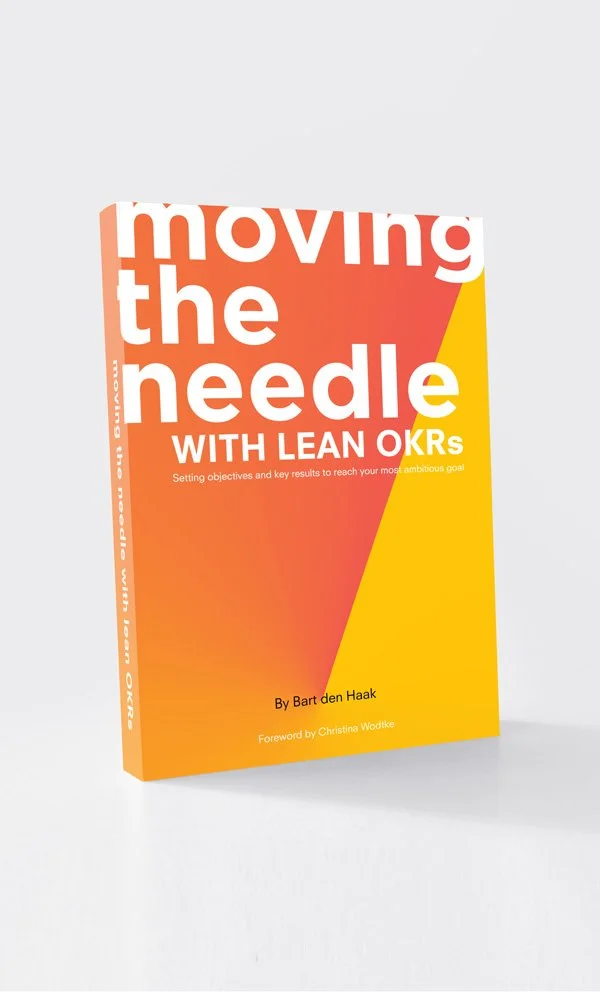
And with that, we wrap up our fictional character Dave’s story. For some people, this story isn’t too far off from real life. If you would like to know more about Lean OKRs, you can order my book “Moving the Needle with Lean OKRs” or you can contact me. I offer a free OKR discovery call for those that are ready to roll up their sleeves and get started with Lean OKRs within their company or organization.
Now Available!

Categories
Making OKRs Lean Again - Part 3
Objectives and Key Results. A 40-year old, simple goal-setting framework, initially created by and for technology companies that needed to innovate at the speed of light. They are still wildly relevant today, some four decades later, and when used correctly, they can help you to achieve 10x growth. The popularity of the tool is….
Welcome back to the third installment of Dave’s experience starting out with OKRs. As you know, the end of the quarter has arrived and their learning curve is huge.
End of the quarter
The end of the quarter arrived. Everyone was asked to report on their OKRs. Teams and departments reported little progress on their OKRs. The Sales team however did great! Dave had already informed Mary that this was to be expected. The first OKR cycle is for learning. All the OKR experts will tell you this. So they decided to give OKRs another try. Dave realized this OKR initiative took more effort than expected. But he learned from the literature that the process takes time, to be patient. He also learned that setting OKRs with so many people takes a lot of preparation. Dave had more on his plate these days, because of onboarding new employees, leading the talent acquisition team and increased sick leave. Therefore, he hired a program manager that could oversee OKRst. His name was Bob. Bob had years of experience in change management programs, so none of what the company was experiencing with OKRs was new to him. As good program managers do, he started to formalize the process. He created mandatory meetings for everybody to attend to smooth out the OKR process. With the company still growing, new people and teams popped up almost every quarter. When it came to setting OKRs for the upcoming quarter, it took three weeks to make sure everybody had filled in their OKRs into the software tool. Regardless, Bob was confident that he could mobilize such a large group of people every quarter to fill in their goals.
Not everybody was happy with the continuation of the OKR initiative within the company. Some people said there were too many meetings now. Some people didn’t enter their OKRs into the OKR software system. In response, Bob started to send automated email reminders to people: “PLEASE FILL IN YOUR OKRs”. After chasing people down, finally, most of them had submitted their OKRs.
This process continued on for almost nine months.
Evaluation
One day, Mary walked in and asked Dave: “We have been using OKRs for 3 quarters now, how is the engagement going on?” Dave responded: “Your timing is perfect! Yesterday, we ran another employee engagement survey, however, the results aren’t that great.” “Oh? How come?” asked his boss. “Well…,” John hesitated to share the findings with her because he didn’t like to be the bearer of bad news. “We only saw a small uptick in the engagement survey, it seems the OKRs didn’t work”. His boss looked confused. “How is that possible? Everybody has now clear goals defined, everything is now made transparent, why aren’t they working?” John replied: “People still complain that they’re missing the bigger picture.” He continued: “And they also don’t like working with OKRs because they see them as an administrative hassle”. His boss replied: “Mmmm, maybe this OKR thing is not for us. I don’t see very many results coming out of it anyway. Yesterday I had a meeting with one of our investors and he talked about OSGM and V2MOM or something. Let’s try that instead. I think it’s a better fit for us.” She looked at Dave: “By the way, can you prepare for the annual performance reviews, it is that time of year again! And we can definitely use the OKRs to evaluate people now.”
Analysis of the story
The problem with Dave’s story is that you probably believe it’s fiction. Unfortunately, this story is more real than you might believe. There are many things that went wrong that I’ve seen in real life, as well.
The main reasons that things go sideways when implementing OKRs are because there is an issue with one or more of the following:
Company culture. It is one based on a command-and-control model and doesn’t have empowered (product) teams.
Focus. There are too many OKRs and the “big picture” isn’t clear.
Purpose. Leaders fail to communicate why they want to use OKRs.
Routine. People get discouraged and disengage due to a lack of visible results (set & forget)
Autonomy: OKRs are set by management (not independent teams) and the OKR software manages the progress on those goals.
We see similar patterns when companies try to adopt “Agile working”, Scrum or trying to scale any of the Agile methods. “We have implemented Jira so we are Agile!” If you struggle to get these things working in your organization, then OKRs are an even tougher challenge for you.
Deciding to jump on the OKR train is usually triggered by some shocking report score, like a poor score in employee engagement. For some time the HR department has been tracking employee engagement and usually, for the lack of any better measurement, they use eNPS. Some more senior HR departments use a more sophisticated survey, like the OHI or Q12. These measurements happen every year or every half year. The trigger to start looking into OKRs is almost always a low score on purpose, lack of direction or low alignment.
The problem is that OKRs are primarily for B2C product-led companies with high-performing software teams. OKRs is Agile on steroids. If you can’t get the basic Agile stuff to work, if your teams don’t master software delivery, if they are not empowered, then OKRs aren’t for you. Well, not yet, at least!
There is a different approach to OKRs that has proven results in large or enterprise organizations. With careful timing, in combination with hiring strong product leaders, you could use OKRs for transforming your existing company culture into a modern product development culture. OKRs can act as the framework for continuous culture transformation.
In my next post and the final installment of Dave’s story, we’ll talk more about where it all went wrong (and what went right!).
Now Available!
Categories
Making OKRs Lean Again - Part 2
Objectives and Key Results. A 40-year old, simple goal-setting framework, initially created by and for technology companies that needed to innovate at the speed of light. They are still wildly relevant today, some four decades later, and when used correctly, they can help you to achieve 10x growth. The popularity of the tool is….
Welcome to the second installment of Dave’s story as he embarks on his OKR journey.
“I want to be able to manage all of these goals,” Mary told him. Dave did a quick search and within no time, he was able to select software that supported his needs. The nice part? The tool also supported the annual performance management AND they offered OKR training. “Isn’t that great?!,” Dave exclaimed, while showing the tool to Mary. The next day, with the approval of Mary, he purchased the OKR software tool. Based on his previous experience with performance management, he understands the importance of such a tool. It should not only help to keep track of people’s goals but also to maintain the transparency of OKRs (which he had learned was vital to the process).
The lovely people working for the OKR software tool company suggested getting some employees “OKR certified” to smoothen the OKR process. He quickly found some volunteers. The marketing intern, the Agile coach (because they are the company-wide “facilitators”, right?) and an engineering manager. They were sent to a one-day OKR training and within a week, all three received their certificate of completion.
“We are ready to start implementing OKRs,” Dave said to Mary. “Next week is the week before the quarter starts. Let’s set the OKRs then.”
Setting OKRs
It’s the following Monday and Dave is really excited about launching OKRs. The CEO gathered all senior management and announced that “...from now on, everybody needs to create OKRs in order to boost employee engagement. Not only will OKRs improve our low employee engagement score, but it will also help with alignment and focus”. She looked at James, the CTO, who is always a bit reluctant to new company changes, and continued: “We have trained some of your colleagues in OKRs and they are now certified internal coaches. They will be helping everybody to set their OKRs.” With a stern tone, she wrapped up by saying: “And I expect each of you to deliver your OKRs before Friday.”
And so it happened. Everybody in the company started to set OKRs. The executing team set OKRs first, then managers set their OKRs, then those same managers set OKRs for their departments: Marketing, Sales, IT, Customer Service, Operations, Engineering, R&D and UX. Then each team was asked to set OKRs, connecting to the department OKRs. And finally, every individual team member was asked to set OKRs themselves.
During the OKR setting process, people had figured out quite quickly that they could transform their current goals to fit the OKR template. So, the Sales teams changed their sales targets into OKRs, Marketing created OKRs for each campaign, Customer Service changed their “Time on the phone targets” to OKRs, Ops their “Uptime targets”, Software engineering their “roadmap items”, UX their retooling goals, and even HR re-wrote their “new hires targets” into OKRs. The leadership team did the same. Revenue, customer satisfaction and EBIT numbers got transformed into OKRs. Even each individual team member converted their personal development goals into OKRs, too!
This resulted in five OKRs at the company level. Five OKRs per department and manager, three to five OKRs per team and the same for each individual. It was as if they were sprinkling some magical OKR fairy dust over all of their existing (and mundane) goals. Lucky for them, they had the OKR software tool to help them manage all of their OKRs.
Dave was in charge of coordinating the OKR rollout, but after one week it was already apparent that not everyone was happy with the changes. He heard complaints from multiple people, such as “OKRs simply don’t work here”, “We also have other work to do, we’re drowning!”, “We already do Scrum, so why do we even need OKRs?” Dave was able to placate them by replying: “I hear what you’re saying but we really need to improve employee engagement and therefore OKRs are necessary”. It is worth mentioning, not everybody was unsatisfied with the changes. Some were quite happy that their leaders took action based on the employee engagement survey result, so they gave the leadership room to try OKRs out and proceeded without too much resistance (something that isn’t always the case in other companies).
During the Quarter
After all the OKRs were set, people got to work. They continued working on the tasks they were assigned to. Developers continued working on the features they received from product owners. After all, the Objective was to “Deliver awesome UI to customers.” UX kept working on the designs for the UI and handed them over to the engineering teams. However, they couldn’t deliver as fast as usual because their OKR was about converting their existing UX designs into a new tool, which took up a lot of their time. Marketing couldn’t make any progress on their OKRs either. They couldn’t launch their new marketing campaign because they depended on engineering to deliver the new UI. At the same time the Engineering team finally received new UI designs from the UX team, the company welcomed a new “big whale” client. The Sales team was on a roll to move the needle of their KRs. This required at least five software teams to pay attention to delivering on this.
At some point, the management team took a look at their OKR software tool and noticed that there was low progress on most of the OKRs. So, they decided to put some pressure on the Ops and software teams to deliver on time. Because the Operations team didn’t have time to automate their own work, they had a hard time with this new customer coming on board. Some teams were working overtime to deliver before the due dates of their “epics”.
The pressure seemed to work. The teams did some amazing work. They were able to push out the UI changes and a new feature before the deadline. “These OKRs work great!” some senior manager boasted over lunch.
The team moved back to working on features for this new major client. Meanwhile, there were new bugs coming in because existing customers were also using the new UI. Some software teams couldn’t focus on the OKRs or the major client anymore because of customer issues. “Maybe next quarter we can set OKRs for reducing bugs and do a big refactor project”, one of the software architects cleverly thought up.
Weeks went by and little progress was made on their OKRs as they worked to keep their heads above water.
In my next post, we will learn more about Dave and his bumpy start with OKRs. Until then, can you predict what the end of the quarter is going to look like for Dave’s company?
Now Available!
Categories
Making OKRs Lean Again - Part 1
Objectives and Key Results. A 40-year old, simple goal-setting framework, initially created by and for technology companies that needed to innovate at the speed of light. They are still wildly relevant today, some four decades later, and when used correctly, they can help you to achieve 10x growth. The popularity of the tool is….
Objectives and Key Results. A 40-year old, simple goal-setting framework, initially created by and for technology companies that needed to innovate at the speed of light. They are still wildly relevant today, some four decades later, and when used correctly, they can help you to achieve 10x growth. The popularity of the tool is still rapidly growing, as measured by the number of software companies developing tooling for it. At the same time, we see companies abandoning them. Why is that? Why is there so much fuss about OKRs anyway? To paraphrase John Cutler: “[...] they are just goals!” They are supposed to be simple.
Let me tell you about a fictional character. Let’s call him Dave. Dave’s story will help to illustrate how most organizations start their OKR journey.
Dave is the HR manager of ACME, a cloud-native scale-up company that develops software to help sales teams find new business contacts. The company grew very fast last year. It went from 200k MRR to 1Mi MRR over 5 years. It now has about 150 employees, distributed over three countries. The leadership team still wants to grow the company and take it to “the next level”. Lately, the company has had some problems with finding and keeping good tech talent. The employee retention rate is very low, especially in engineering. Therefore, Dave decided to do an Employee Engagement survey to find out what was going on. When the results came back, he quickly found out that one topic in particular stood out: People wanted to have a clear direction, focus and better alignment (which was currently absent, according to a very large majority, despite there being a strategy paper that was written and shared back in December).
It’s Sunday morning and Dave is reading his favorite HR magazine and learns about OKRs for the first time. He gets really excited when he reads about how this tool has boosted morale, alignment and engagement in a company similar to his. This tool looks very promising; it seems like a simplified version of an employee performance system. Simplicity is key, which is something that Dave values. It makes perfect sense to start using OKRs to see if will help to “fix” the employee engagement problems within his company.
That same week, Dave dove into OKRs and spent some of his evenings researching the topic. He did a Google search and quickly found some interesting articles but also found that the information available was a bit scattered, so he bought a book on OKRs. Two weeks later, Dave read the book cover to cover and was convinced. This can really help the company improve engagement! The next day, he sits down with Mary, the CEO of the company. He tells her what he had learned and how this new tool could help boost employee engagement, and thus, retention. Getting Mary on board with OKRs was easy. Who doesn’t want to have highly engaged people? Within thirty minutes, they agreed: “Let’s start using them in the next quarter”. The start of the next quarter was coming up in three weeks’ time.
In the next post, we continue with Dave’s story. Until then, how hard do you think it could possibly be for Dave’s company to implement OKRs?
Now Available!